Guardian Cryptic Crossword Answers & Setters Guide (2026)
Find today's Guardian cryptic crossword answers, explore famous setters like Paul & Araucaria, and learn beginner tips to solve faster. Start now.

The Guardian cryptic crossword has built a loyal following among solvers who enjoy puzzles that reward wit as much as logic. Unlike the stricter Telegraph style, the Guardian is known for its playful clues, clever wordplay, and famous setters with distinctive personalities and dedicated fan bases.
This updated 2026 Cryptic Crossword Solver guide covers today's Guardian cryptic crossword answers, popular setters, puzzle types, and practical solving tips. You'll also learn how difficulty changes throughout the week and discover a simple path for beginners who want to improve their skills and solve with confidence.
What Is the Guardian Cryptic Crossword?
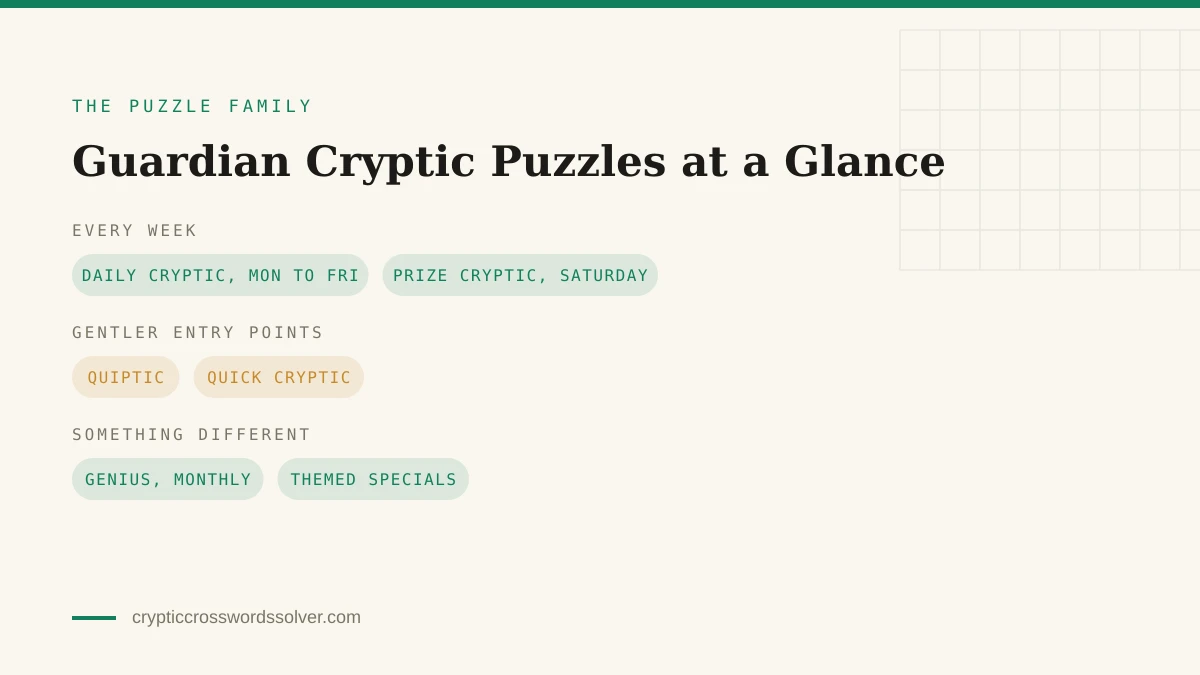
The Guardian cryptic crossword is the newspaper's flagship daily puzzle, published Monday through Saturday, with the Saturday edition running as the Prize puzzle. Alongside it sits the Quiptic, an easier weekly cryptic aimed at newer solvers. It ranks with the Telegraph and the Times as one of the three major British cryptic crosswords, but has earned a distinct identity through its setters' willingness to bend convention.
History of the Guardian Crossword
The Guardian's crossword tradition dates back to 1929, when the paper was still the Manchester Guardian, and it grew alongside the broader British cryptic crossword boom of the mid-20th century. Setters stayed anonymous until December 1970, when the paper began printing their pseudonyms; Araucaria was one of the names born that month. Over the decades the puzzle built a reputation as the more liberal, less rule-bound alternative to the Telegraph's strict Ximenean style, attracting setters who enjoyed pushing the boundaries of what a "fair" clue could look like.
Why the Guardian Cryptic Is Different
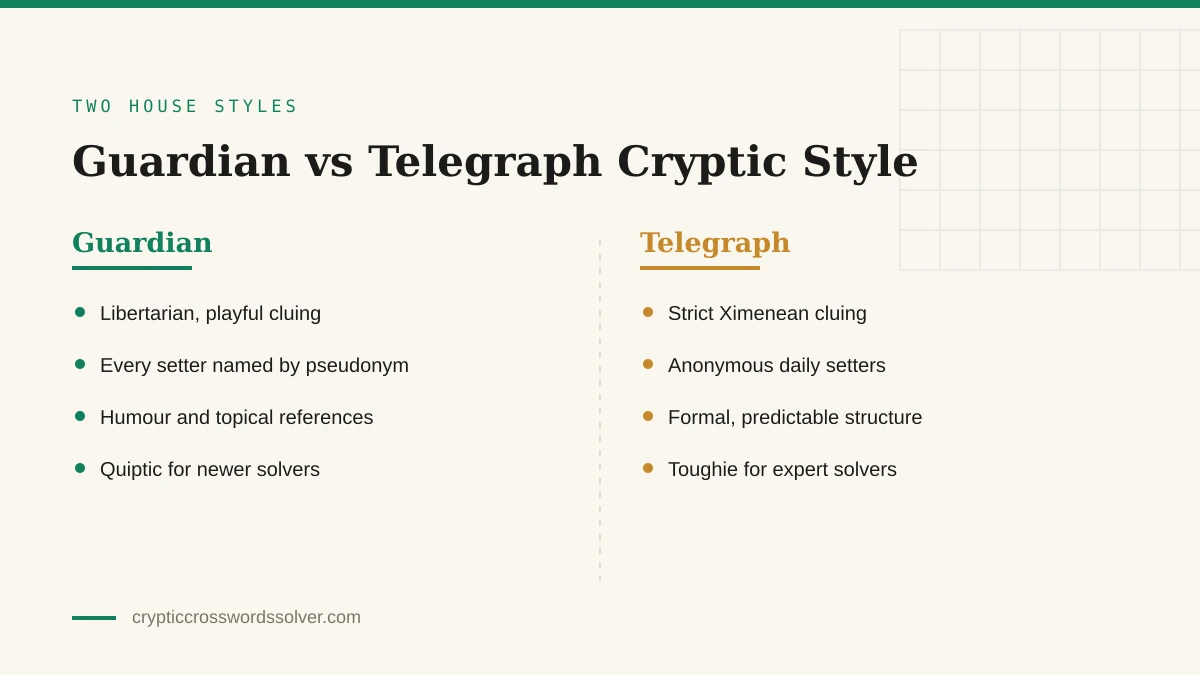
Where the Telegraph prizes strict adherence to Ximenean conventions, the Guardian leans toward a looser, more playful tradition often associated with the term "Libertarian" setting. Clues can take more creative liberties with surface readings, wordplay structure, and humour, which makes the puzzle feel distinct in tone even when using the same ten core clue types. To see the stricter school up close, our guide to the Daily Telegraph cryptic crossword walks through the Ximenean rules one by one.
How Guardian Cryptic Clues Work
Like all cryptic crosswords, every Guardian clue combines a straight definition with a separate wordplay route to the same answer. What sets the paper apart is less the mechanics and more the personality: Guardian setters are known for clues with a sense of humour, occasional topical references, and a willingness to surprise solvers who expect a stricter formula.
Guardian Cryptic Crossword Puzzle Types
The Guardian doesn't publish just one cryptic crossword. It runs a small family of puzzles aimed at different solvers and different days of the week.
Daily Guardian Cryptic
The main cryptic crossword runs Monday through Saturday, set by a rotating cast of named setters, each bringing a slightly different flavour to the week. The setter's pseudonym is printed with every puzzle, so you know whose style you are about to face before you read the first clue.
Guardian Prize Crossword
Published on Saturdays, the Prize crossword is an often themed, more elaborate puzzle that readers can submit for a chance to win a prize, adding an extra layer of engagement beyond the daily solve. Because it is a competition, its solution is held back until entries close.
Quiptic for Beginners
The Quiptic is the Guardian's dedicated easier puzzle, a weekly cryptic designed specifically for solvers who are new to cryptic crosswords or want a gentler challenge before tackling the full cryptic. The Guardian has since added a weekly Quick Cryptic as well: a compact 11 by 11 grid designed to teach the basics.
Weekend and Special Puzzles
Beyond the standard lineup, the Guardian occasionally runs special themed puzzles tied to holidays, anniversaries, or notable events, giving regular solvers something different to look forward to outside the usual weekly rhythm. Experienced solvers also have the monthly Genius, a tougher puzzle that often comes with special instructions.
Guardian Cryptic Crossword Answers: Where to Find Solutions
Today's Guardian Crossword Answers
The Guardian publishes its own crossword archive on its website, where solvers can access the current puzzle and recent back issues directly from the source. On the interactive version of a standard daily cryptic you can check or reveal a single answer or the whole grid, which makes it easy to confirm one entry without spoiling the rest. Prize puzzles are the exception: their solutions stay hidden until entries close.
Best Free Websites for Guardian Solutions
Several dedicated crossword-blogging communities publish daily explanations of Guardian puzzles shortly after release, breaking down each clue's definition and wordplay. These blogs are typically run by enthusiast solvers and are free to read, often with a comment section where solvers discuss tricky clues. The best known is Fifteensquared (fifteensquared.net), which blogs the daily cryptic, the Quiptic and the Quick Cryptic, and covers each Prize puzzle once the competition has closed.
If you only need one stubborn answer rather than the whole grid, a letter-pattern search is a gentler nudge. Enter the letters you already have from crossing answers, then test each candidate against the clue's wordplay before you write it in.
How Answer Explanations Help You Improve
Reading a full breakdown of a clue you couldn't solve, rather than just the answer, is one of the fastest ways to build real cryptic skill, since you see exactly which indicator word you missed or which abbreviation you didn't recognise. Keep a running list of the ones that catch you out; our cryptic crossword abbreviations guide covers the short codes Guardian setters lean on most.
Guardian Crossword Setters Guide
Why Guardian Setters Matter
Because the Guardian publishes named setters with distinct, recognisable styles, regular solvers often develop preferences for certain setters' puzzles, learning to anticipate their favourite tricks and recurring themes.
Guardian Setter Names and Styles
Guardian setters typically write under a pseudonym, and over time each builds a reputation: some are known for tight, elegant wordplay, others for outright humour or unusually creative surface readings. Many also set for other papers under different names. Paul is John Halpern, who appears as Dada in the Telegraph Toughie, and Brendan is Brian Greer, who has long set the Sunday Telegraph cryptic. Learn a setter's habits in one paper and you have a head start in the other.
Most Popular Guardian Setters Explained
Among the most discussed setters are those known for a particularly playful or distinctive voice, often generating the most lively discussion on solving blogs the day their puzzle appears. Araucaria, the pseudonym of the Rev John Graham, remains the benchmark: he set Guardian puzzles for decades before his death in 2013, and his inventive, often thematic crosswords are still solved and celebrated from the archive.
Guardian Crossword Setters and Their Styles
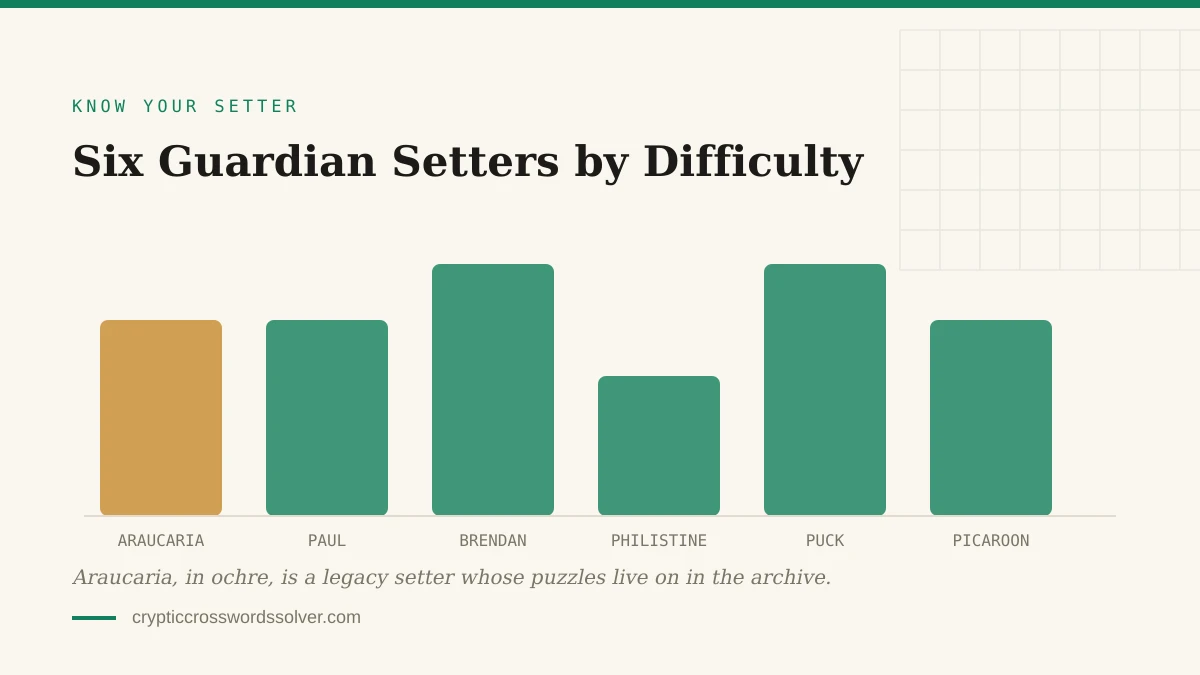
| Setter | Known Style | Difficulty Level | What Solvers Say |
|---|---|---|---|
| Araucaria (legacy) | Inventive, boundary-pushing, thematic | Moderate to hard | Widely regarded as one of the most beloved and influential setters in Guardian history |
| Paul | Witty, irreverent, often topical | Moderate to hard | Known for humour and clues that reward lateral thinking |
| Brendan | Thematic, structurally inventive | Hard | Praised for puzzles built around a clever unifying idea |
| Philistine | Smooth surfaces, fair but testing | Moderate | Liked for clues that read naturally despite tricky wordplay |
| Puck | Mischievous, playful misdirection | Hard | Known for puzzles that reward patience and a sense of humour |
| Picaroon | Elegant, modern, precise | Moderate to hard | Praised for clean construction and satisfying "aha" moments |
Treat the difficulty column as a rough guide rather than a fixed rule: any setter can produce a gentler or a fiercer puzzle on a given day.
Guardian Cryptic Difficulty by Day
Monday to Friday Difficulty Pattern
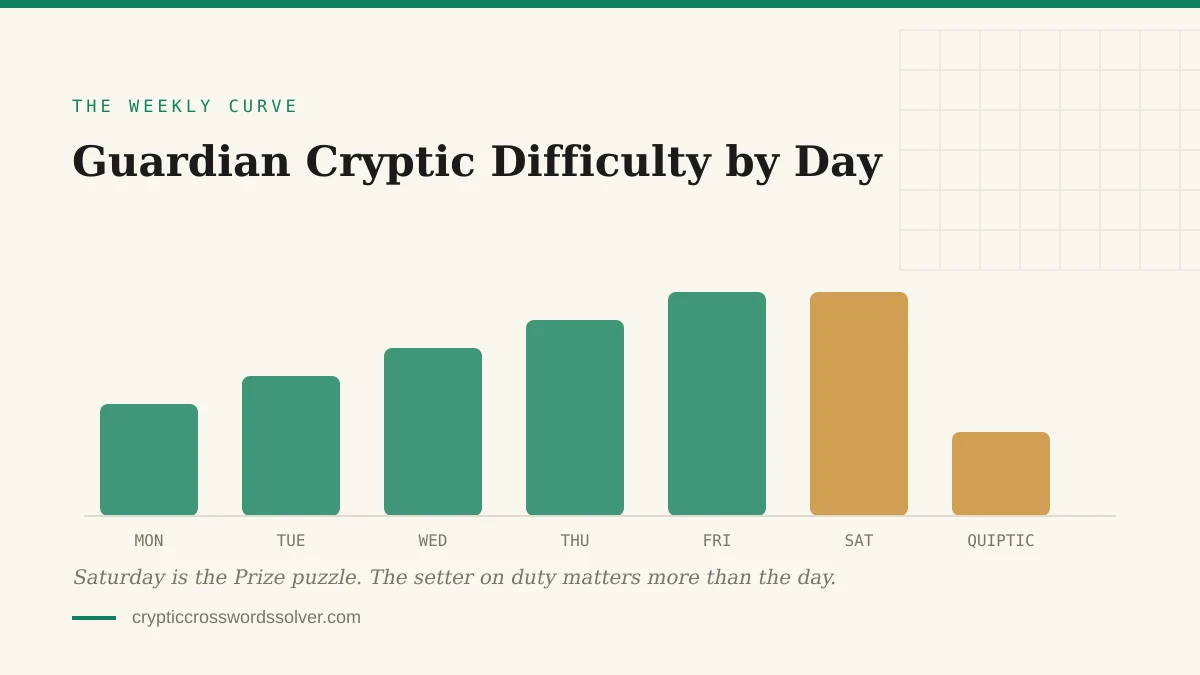
Like most British cryptics, the Guardian's daily puzzle tends to start gentler early in the week and builds toward a tougher challenge by Friday, though the exact difficulty depends heavily on which setter is on duty that day.
Weekend Crossword Difficulty
The Saturday Prize puzzle is typically more elaborate and time-consuming than a standard weekday cryptic, often built around a theme that ties several clues together, rewarding solvers who notice the pattern early.
Which Guardian Puzzle Is Best for Beginners?
The Quiptic is consistently the best starting point for beginners, offering the same core clue types as the full cryptic but with gentler wordplay and more generous surface readings. The Quick Cryptic makes a good warm-up too, since its smaller grid gets you through a complete puzzle quickly.
Beginner Guide: How to Solve Guardian Cryptics
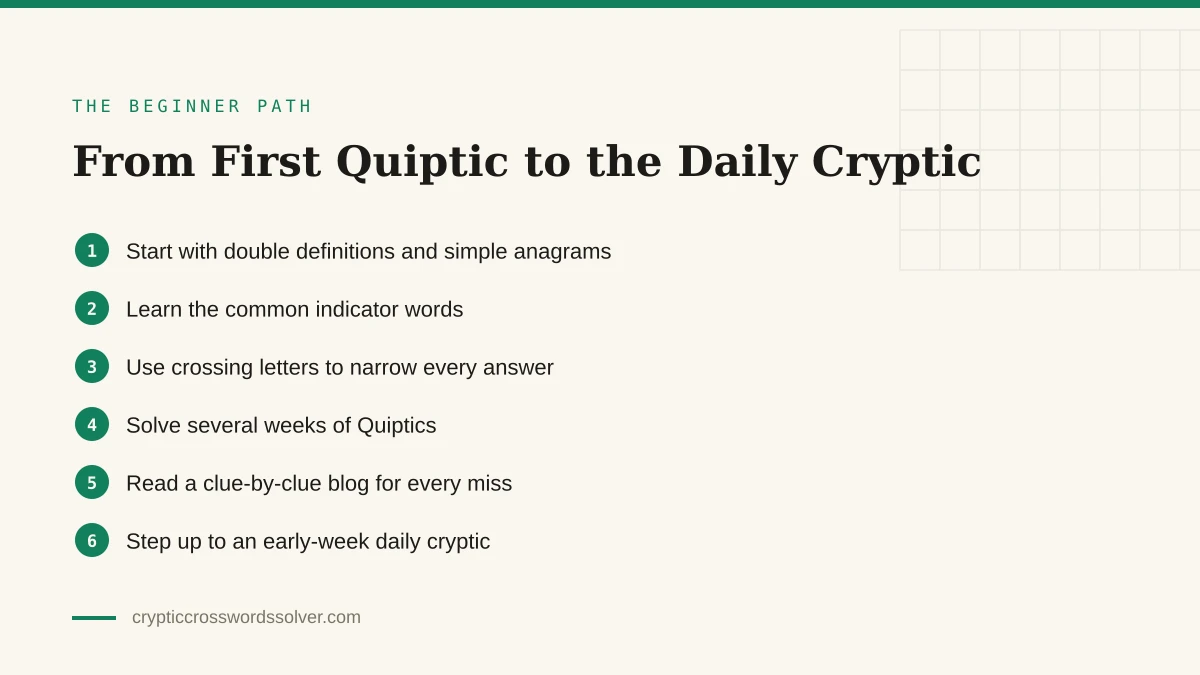
These four habits are the Guardian-specific short version. For the whole method, step by step, see our complete beginner's guide to solving cryptic crosswords.
Start With Easy Clue Types
Double definitions and straightforward anagrams are the easiest entry points, since they require the least specialised vocabulary or setter-specific knowledge.
Learn Common Crossword Indicators
Build familiarity with the standard indicator words for anagrams (mixed, wild, broken), hidden words (in, within, part of), reversals (back, returning, up) and containers (around, holding, inside). These recur constantly across setters and puzzles, regardless of individual style.
Use Crossing Letters Effectively
Use the letters you've already filled in from crossing answers to narrow down possibilities for a stubborn clue, rather than trying to solve every clue in total isolation.
Practice With Quiptic First
Working through several weeks of Quiptic puzzles before moving to the full cryptic builds confidence with the core mechanics in a lower-pressure environment.
Common Guardian Cryptic Clue Types
Guardian setters draw on the same toolkit as every other British cryptic, and these five types turn up in almost every puzzle. The examples below are illustrative clues written to show each mechanic cleanly. For all ten types with full indicator lists, see the complete guide to cryptic crossword clue types.
Anagram Clues
Clues that rearrange a set of letters, signalled by an indicator word suggesting disorder or change, to spell out the answer.
Example: Wild west goulash (4) gives STEW. "Wild" is the anagram indicator, the letters of WEST are rearranged, and a goulash is a stew.
Hidden Word Clues
Clues that bury the answer across consecutive letters within a longer phrase, often flagged with words like "within" or "part of".
Example: Annual, seen inside the cathedral very early (6) gives YEARLY. "Seen inside" flags the hidden word, which runs across the join between "very" and "early", and annual means yearly.
Charade Clues
Clues that build the answer piece by piece, stringing together smaller words or abbreviations end to end.
Example: Vehicle then animal gives floor covering (6) gives CARPET. Vehicle is CAR, animal is PET, and CAR then PET spells the floor covering.
Reversal Clues
Clues where the answer is formed by reading another word or phrase backwards, often signalled by words suggesting return or upward movement.
Example: Beer sent back is splendid (5) gives REGAL. Beer is LAGER, "sent back" reverses it, and REGAL means splendid.
Double Definition Clues
Clues offering two separate definitions back to back that both point to the same answer, without any letter manipulation involved.
Example: Dog's cry, tree's outer layer (4) gives BARK. Both halves are genuine meanings of the same four-letter word.
Best Tips to Solve Guardian Crossword Faster
Solve Definitions First
Identify the definition at the start or end of the clue before tackling the wordplay, since it narrows down the possible answer immediately.
Look for Indicator Words
Train yourself to scan for indicator words tied to each clue type: they're the fastest signal for which technique a clue is using.
Ignore Misleading Surface Meanings
Guardian setters are particularly skilled at writing clues that read like a normal, innocent sentence. Don't let the surface meaning distract you from the underlying wordplay.
Build a Daily Solving Habit
Consistent daily practice, even just a few clues at a time, builds pattern recognition far faster than occasional long sessions.
Frequently Asked Questions
Is the Guardian Cryptic harder than the Telegraph crossword?
The difficulty depends on the setter and the puzzle type. Many solvers find the Guardian harder because of its playful and less predictable clue style, while the Telegraph follows stricter clueing rules.
Who are the most famous Guardian crossword setters?
Some of the best-known Guardian setters include Araucaria, Paul, Brendan, Puck, Philistine, and Picaroon. Each has a unique style and solving experience.
What is Guardian Quiptic?
Guardian Quiptic is an easier cryptic crossword designed for beginners. It introduces the same clue types found in the main puzzle but uses simpler wordplay.
Where can I find today's Guardian crossword answers?
You can find Guardian crossword answers and explanations through the Guardian's archive and dedicated crossword blogs that provide clue-by-clue breakdowns.
How can beginners learn Guardian cryptics?
Beginners should start with Quiptic puzzles, learn common indicator words, and study clue explanations regularly to improve solving skills.
How often is the Guardian cryptic crossword published?
The Guardian publishes its main cryptic crossword from Monday to Saturday, along with special puzzles and the beginner-friendly Quiptic.
What types of clues appear in Guardian cryptics?
Guardian puzzles commonly include anagrams, hidden words, charades, reversals, double definitions, and container clues.
Do Guardian crossword setters use pseudonyms?
Yes, most Guardian setters publish under pseudonyms rather than their real names, and many develop distinctive styles that regular solvers recognise.
Conclusion
The Guardian cryptic crossword offers something for every solver, from complete beginners learning basic clue types to experienced enthusiasts tackling complex wordplay. Understanding the different puzzle formats, recognising setter styles, and learning common solving techniques can make each crossword more enjoyable and less intimidating. With regular practice, the right resources, and familiarity with popular Guardian setters, you can steadily improve your solving skills and approach even the toughest puzzles with confidence.