Cryptic Crossword Abbreviations: The Complete Reference
A full A to Z of the abbreviations that power cryptic crossword charades, containers and deletions, plus the indicator words that tell you one is in play.

Abbreviations are the quiet workhorses of cryptic crosswords. They rarely announce themselves, yet they sit inside a huge share of charade, container and deletion clues, silently doing the job of one or two letters at a time. This Cryptic Crossword Solver guide walks through every level of abbreviation knowledge, from the basics you will meet on day one to the rarer, setter-specific shorthand that trips up even experienced solvers.
What makes abbreviations so important
A single abbreviation can shrink a whole word down to one or two letters, which gives setters a compact, flexible tool for building longer answers piece by piece. Without recognising them, a perfectly logical clue can look like nonsense.
How setters use abbreviations as hidden code
Setters treat abbreviations like a private alphabet shared with solvers. A word like "doctor", "saint" or "new" might never mean its full self in the clue. Instead it quietly stands for "DR", "ST" or "N". Recognising this hidden code is half the battle in solving charades.
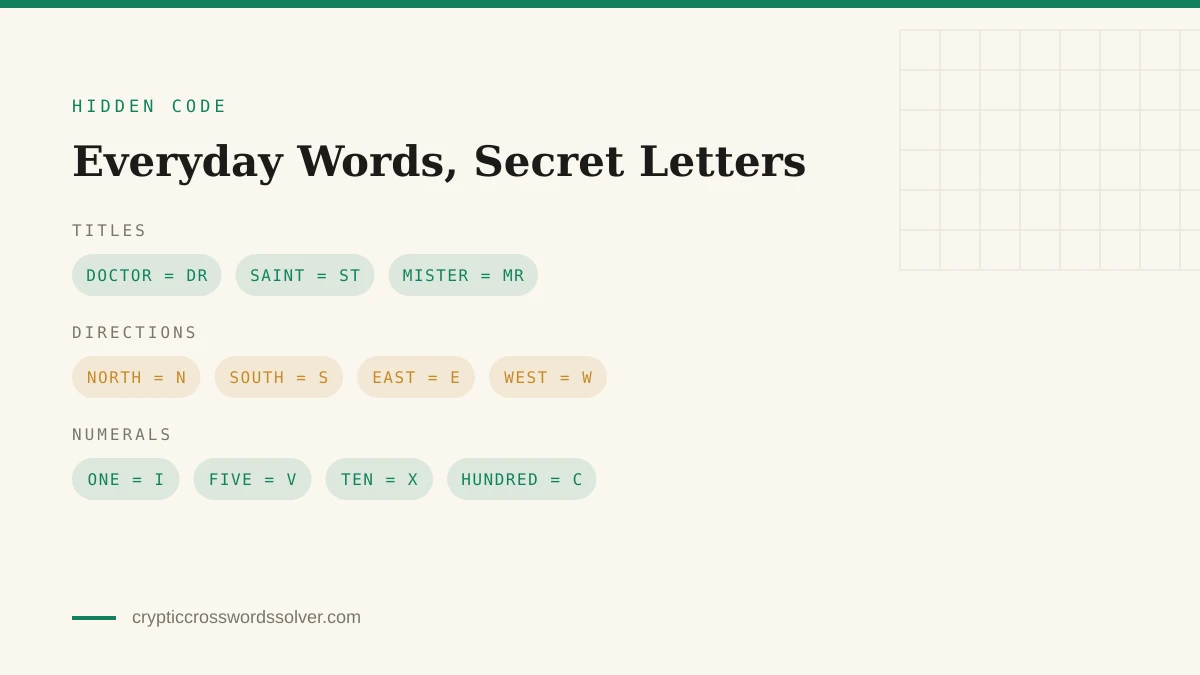
Why beginners struggle with abbreviations, and how to fix it fast
Beginners struggle because they read every word in a clue at face value, expecting it to keep its everyday meaning. The fix is simple but takes practice: train yourself to ask "could this short, ordinary-looking word actually be standing in for a letter code?" every time you hit a stubborn clue.
How abbreviations work in cryptic clues
Before memorising lists, it helps to understand the mechanics behind how and where abbreviations slot into clues.
Abbreviations as word substitutes in wordplay
Think of an abbreviation as a stand-in actor. The clue uses an everyday word, but that word's job is really to hand over a couple of letters to the wordplay, not to contribute its full meaning to the sentence.
How context changes the meaning of the same abbreviation
The same short word can point to different letters depending on the puzzle and the surrounding clue. "Doctor" might mean DR in one clue and MD in another, while "saint" usually means ST but could occasionally suggest something else depending on the setter's style.
Where abbreviations usually appear
Abbreviations tend to show up as small fragments inside charade clues, joined end to end with other fragments, or as the filling or container in insertion clues. They rarely appear as the entire answer on their own, since most answers are full words. The ten clue types that use them most are charades, containers and deletions.
Beginner-level abbreviations
Common personal titles
| Clue word | Abbreviation |
|---|---|
| Mister | MR |
| Doctor | DR |
| Saint | ST |
| Street | ST |
| Reverend | REV |
Basic directions
| Clue word | Abbreviation |
|---|---|
| North | N |
| South | S |
| East | E |
| West | W |
Everyday short forms
| Clue word | Abbreviation |
|---|---|
| Road | RD |
| Avenue | AVE |
| Limited | LTD |
| Company | CO |
Simple Roman numerals
| Clue word | Abbreviation |
|---|---|
| One | I |
| Five | V |
| Ten | X |
Intermediate abbreviations you see in most puzzles
Royal and government references
| Clue word | Abbreviation |
|---|---|
| King or queen | R (Rex or Regina) |
| Queen Elizabeth | ER |
| Member of Parliament | MP |
| Prime Minister | PM |
Church and religious short forms
| Clue word | Abbreviation |
|---|---|
| Church of England | CE |
| Old Testament | OT |
| New Testament | NT |
Academic degrees and professional titles
| Clue word | Abbreviation |
|---|---|
| Bachelor of Arts | BA |
| Master of Arts | MA |
| General practitioner | GP |
| Queen's Counsel | QC |
Latin-based abbreviations
| Clue word | Abbreviation |
|---|---|
| Circa, or about | C |
| And (from Latin et) | ET |
| And others (from et al.) | AL |
Advanced abbreviations (hard level)
Scientific symbols
| Clue word | Abbreviation |
|---|---|
| Hydrogen | H |
| Oxygen | O |
| Sodium | Na |
| Iron | Fe |
Musical notes
Do, Re, Mi, Fa, Sol, La and Ti are the solfège syllables, often clued through musical references like "note" or "scale".
Rare or setter-specific abbreviations
Some setters lean on house-style shorthand that is less universal: regional postal codes, niche military terms, or older abbreviations no longer common in everyday English. These appear less often but are worth noting once you spot them repeating in a particular publication, such as the Daily Telegraph, where each Toughie setter has a recognisable style of their own.
Multi-layer abbreviation tricks
Advanced clues sometimes stack two or three abbreviations together inside a single charade, asking you to extract multiple short codes before assembling the final word. These require patience and a willingness to test combinations rather than expecting one obvious answer.
Full A to Z abbreviations reference table
| Letter | Common meanings in clues |
|---|---|
| A | ace, area, angstrom |
| B | bishop (chess), black, born |
| C | hundred (Roman numeral), circa |
| D | five hundred (Roman numeral), died |
| E | east |
| F | female, fellow |
| G | good |
| H | hydrogen, hot |
| I | one (Roman numeral), island |
| J | jack (cards) |
| K | king, thousand |
| L | fifty (Roman numeral), learner |
| M | thousand (Roman numeral), male |
| N | north, new |
| O | nothing or zero, oxygen |
| P | parking, page |
| Q | queen, question |
| R | king or queen (Rex or Regina), river, right |
| S | south, small |
| T | time, ton |
| U | university, universal (film rating) |
| V | five (Roman numeral), versus |
| W | west, with |
| X | ten (Roman numeral), kiss |
| Y | unknown (algebra), young |
| Z | zero (informal) |
How abbreviations hide inside cryptic clues
Abbreviations in charade clues
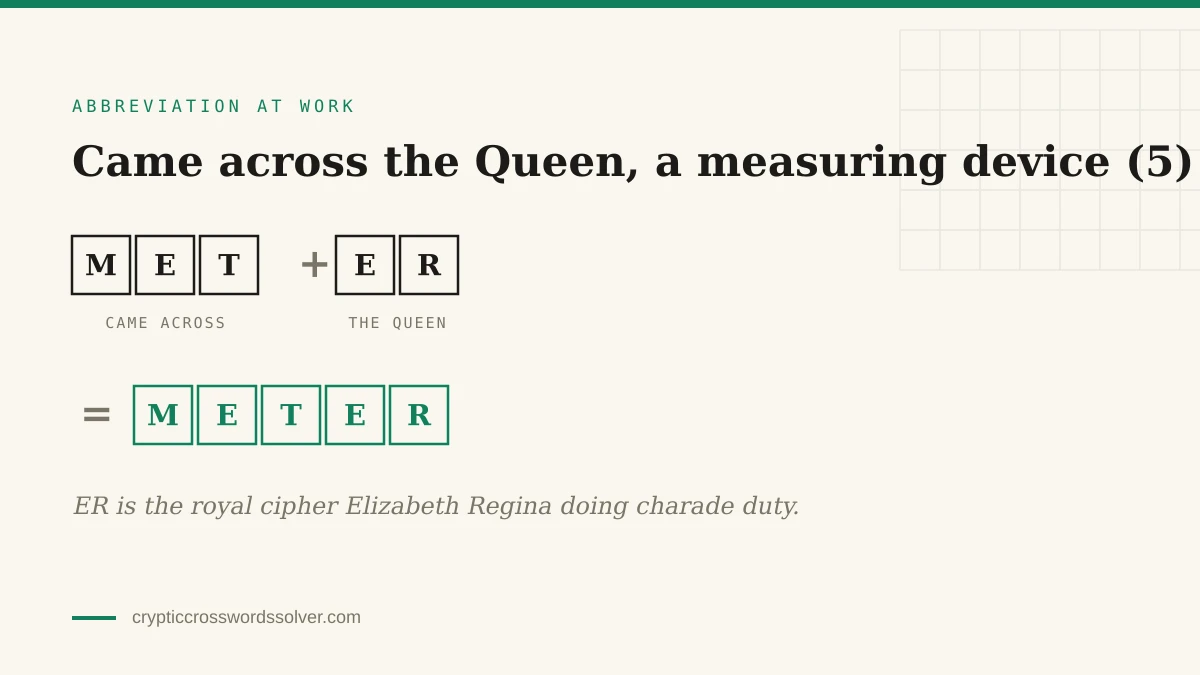
In a charade, the answer is built by joining smaller pieces end to end, and abbreviations are one of the most common pieces used, since they let the setter clue a short fragment in just one or two words. Elizabeth Regina's cipher, ER, is a favourite: "came across the Queen" gives MET + ER, forming METER. See the complete beginner's guide for the rest of the charade mechanic, worked example included.
Abbreviations inside container clues
In container clues, an abbreviation can act as the small piece that gets inserted inside a larger word, or as the outer shell that holds a smaller fragment inside it.
Abbreviations in reversal and deletion clues
Abbreviations can also be reversed, read backwards as part of a longer reversal trick, or removed from a longer word as part of a subtraction clue, especially when the setter wants to drop a short, recognisable code from the front or back of a word.
Mixed clue types using multiple abbreviations
The hardest clues often combine abbreviations with anagram indicators, hidden-word tricks or homophones all in the same line, asking you to find more than one type of wordplay layered together.
Indicator words that signal an abbreviation
Words that show short forms
Words like "briefly", "for short", "in short" or "abbreviated" are direct signals that a nearby word should be reduced to its standard abbreviation rather than used in full.
Context clues that suggest letters instead of words
Even without an explicit indicator, an unusually short or oddly specific word in the wordplay section, rather than the definition section, often hints that it is standing in for a letter code.
How grammar helps identify abbreviations faster
Pay attention to whether a word is doing the job of the definition or the job of the wordplay. If a word sits firmly in the wordplay half of the clue and has a well-known short form, it is far more likely to be functioning as an abbreviation.
Step-by-step method to decode abbreviations in any clue
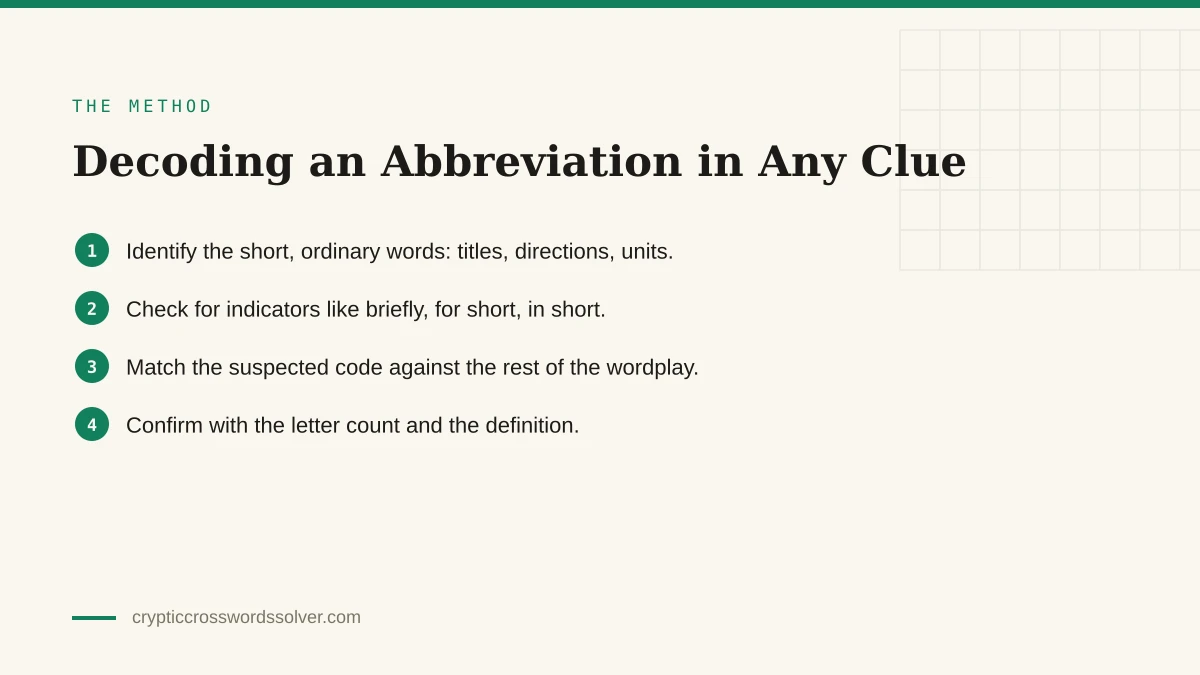
- Identify possible short words. Scan the clue for short, ordinary words: titles, directions, units, or single nouns that have a commonly known abbreviation.
- Check for common abbreviation indicators. Look for supporting language like "briefly" or "for short" that confirms the setter intends an abbreviation rather than the full word.
- Match clue context with known abbreviations. Test the abbreviation you suspect against the rest of the wordplay to see if it fits logically with the other fragments being joined, inserted, or removed.
- Confirm with word length and definition. Check that your assembled answer matches both the required letter count and the separate definition elsewhere in the clue. If both line up, your abbreviation guess is correct.
Most frequently used abbreviations
Top 10 must-know abbreviations for beginners
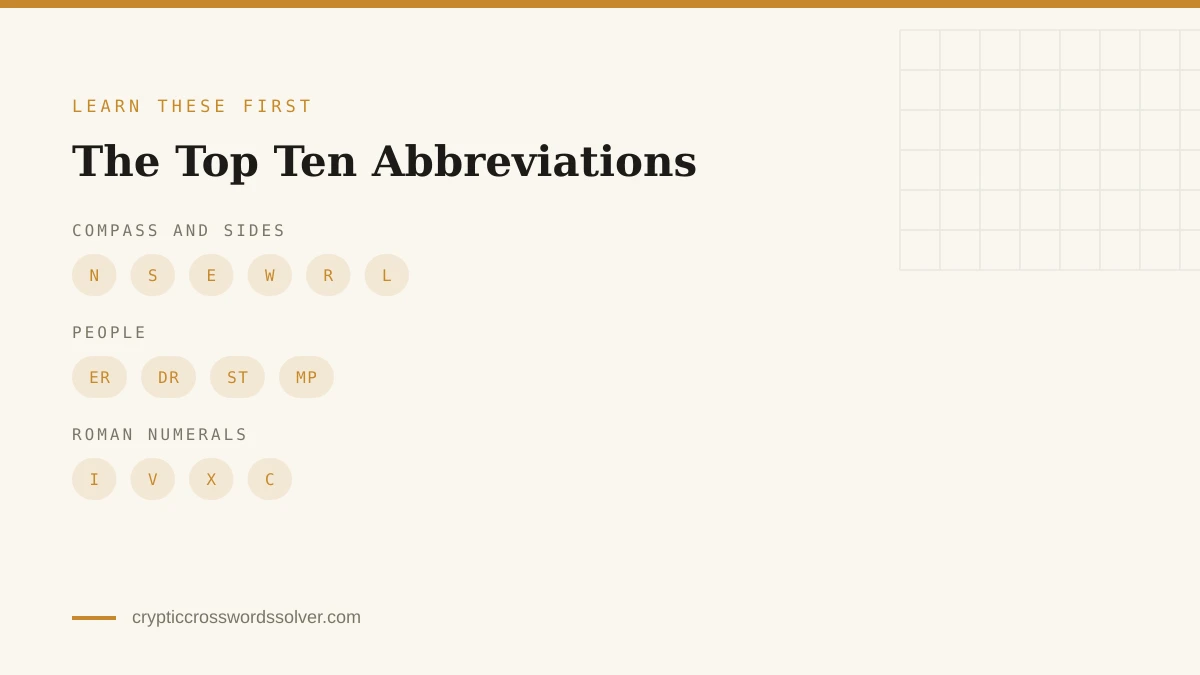
N, S, E, W, R, ER, ST, DR, MP, and the Roman numerals I, V and X cover an enormous share of beginner-level abbreviation clues across most puzzles.
Why these appear in almost every puzzle
These codes are short, flexible and tied to extremely common everyday words, which makes them easy for setters to clue naturally without the sentence sounding forced.
Quick memorisation techniques
Group abbreviations by theme, directions together, titles together, Roman numerals together, rather than trying to memorise one giant alphabetical list. Themed grouping mirrors how your brain will actually recognise them mid-solve.
Practice: spot the abbreviation
Try spotting the abbreviation in a clue like "Doctor's title before article (2)". The hint here is that "doctor" is pointing to a two-letter abbreviation, not the full word: DR.
Once comfortable, attempt clues without flagged hints, relying only on indicator words like "briefly" or "for short" to know an abbreviation is in play. After attempting a clue, always walk back through which word supplied which abbreviation, and confirm the full answer matches the definition. This habit builds long-term recognition far faster than guessing and moving on.
Common mistakes learners make
- Assuming one meaning for every abbreviation. A frequent beginner error is locking onto the first meaning learned for an abbreviation and refusing to consider alternatives, even when the context clearly points elsewhere.
- Ignoring context in the clue. Skipping over the surrounding wordplay and definition makes it easy to misapply an abbreviation that technically exists but does not fit this particular clue.
- Overlooking simple short forms like R or N. Ironically, the simplest one-letter codes are often the easiest to miss, since solvers expect tricks to be complicated and overlook the obvious.
Expert strategies to master abbreviations quickly
- Learn through real puzzle exposure. Nothing builds recognition faster than solving real puzzles regularly and noting every abbreviation you encounter as you go, rather than studying lists in isolation.
- Build a personal quick-reference sheet. Keep your own running sheet of abbreviations sorted by category, updated every time you meet a new one. Your personal list will end up more useful than any generic reference.
- Favour pattern recognition over memorisation. Over time, you will start recognising abbreviation patterns automatically, the same way frequent readers recognise common words without sounding them out letter by letter.
- Combine abbreviations with other wordplay types. Many advanced clues pair abbreviations with anagrams, containers or reversals in the same line, so practise spotting abbreviations as part of a larger wordplay puzzle, not just in isolation.
Frequently asked questions
Are abbreviations the same in every crossword? Most core abbreviations are shared across publications, but some setters and regions use slightly different conventions, so a small amount of variation is normal.
Do setters invent new abbreviations? Occasionally, yes, especially for modern terms or regional references, though the vast majority of abbreviations used are well established and recur across many puzzles.
How many abbreviations should I learn first? Focus on the ten to twenty most common abbreviations first, covering directions, titles and basic Roman numerals, before expanding into rarer or subject-specific codes.
What is the fastest way to memorise them? Active exposure through real puzzles, paired with your own categorised reference sheet, beats passive memorisation of a static list every time.
Conclusion
Once abbreviations stop feeling like hidden traps and start feeling like familiar shorthand, entire categories of clues that once felt impossible become quick, reliable wins.
Keep practising with real puzzles, build your own categorised cheat sheet, and always confirm your answer against both the definition and the word length. Abbreviations are a small piece of the cryptic crossword toolbox, but mastering them pays off in nearly every puzzle you solve. Back on the homepage, the free solver and full clue-type guide cover the rest of the toolbox.