Cryptic Crossword Clue Types: All 10 Patterns Explained
Every cryptic crossword clue is built from one of ten wordplay patterns. Learn to spot each one, plus the rarer tricks that show up often enough to know on sight.

Cryptic crosswords look like nonsense the first time you meet them. A clue reads like a tiny riddle wrapped inside a sentence, with no obvious question and no obvious answer. Once you understand the system behind them, that nonsense turns into a puzzle you can solve on purpose, not by luck. This Cryptic Crossword Solver guide breaks down every major clue type, the logic that powers each one, and the method solvers use to crack them.
Why cryptic clues feel impossible at first
Beginners usually try to read a cryptic clue the way they would read a normal sentence. That is the first mistake. Cryptic clues are not sentences meant to be understood: they are instructions meant to be decoded. The words are chosen for double duty. They sound natural in the sentence, but they are secretly pointing to letters, instructions, or hidden tricks.
That double duty is exactly why the clues feel impossible at first. You are not missing intelligence. You are missing the decoder ring.
The hidden logic behind every clue
Every cryptic clue is built on a strict, consistent set of rules. Setters, the people who write the puzzles, are not trying to be unfair or random. They follow a known toolbox of techniques, and that toolbox has barely changed in a century. Once you learn it, you start recognising the same handful of patterns appearing again and again, just dressed in different words.
Stop reading sentences, start reading patterns
The real shift that turns a beginner into a confident solver is this: stop reading clues as sentences and start reading them as patterns. Instead of asking "what does this sentence mean?", ask "which part is the definition, and which part is the wordplay trick?" That single change in mindset is responsible for more breakthroughs than any vocabulary list.
The two-layer system every cryptic clue uses
Almost every cryptic clue, with one rare exception covered below, is built from two layers stacked together: a straight definition and a wordplay section that builds the same answer a different way. Both layers point to the exact same word. Your job is to find both, and use one to confirm the other.
Definition vs wordplay, explained simply
The definition is usually a normal dictionary-style synonym, sitting at the very start or very end of the clue. The wordplay is everything else: the part that uses anagrams, hidden words, letter tricks, or sound games to spell out that same answer through a completely different route. Think of it as two witnesses describing the same suspect from different angles.
Why every clue has only one correct answer
Because the definition and the wordplay both have to agree, a properly written cryptic clue only ever has one valid answer, even though it might feel ambiguous at first glance. If your answer fits the definition but the wordplay does not add up, it is not right yet. This built-in double-check is what makes cryptic clues fair, even when they are hard.
The complete map of cryptic clue types: 10 core patterns
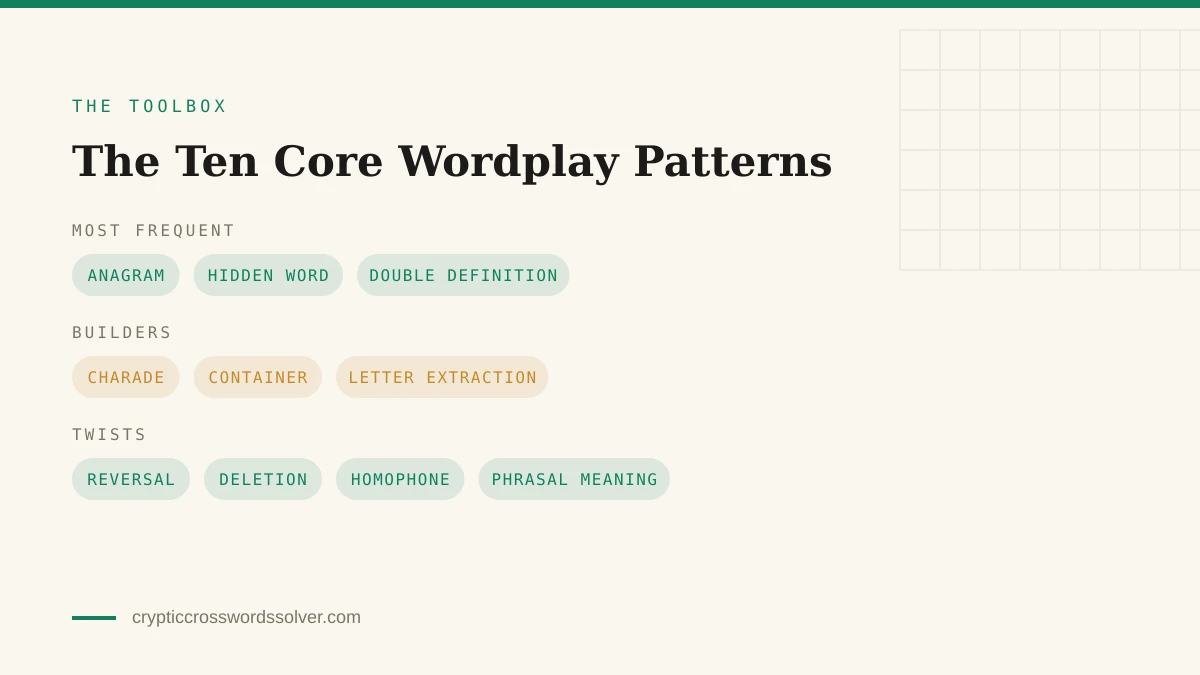
Underneath the surface variety, there are really only ten core wordplay patterns you need to know. Learn these ten and you can solve the vast majority of clues in any cryptic crossword, from quick daily puzzles to advanced cryptics like the Daily Telegraph's Toughie.
Which clue types appear most often in real puzzles
In most published puzzles, anagram clues, hidden-word clues and double-definition clues show up the most frequently, simply because they are flexible and easy for setters to build. Container and charade (word-building) clues come next in frequency. Rarer types like spoonerisms appear occasionally, often as a fun curveball rather than a staple.
Pattern 1: letter jumble clues (anagrams made simple)
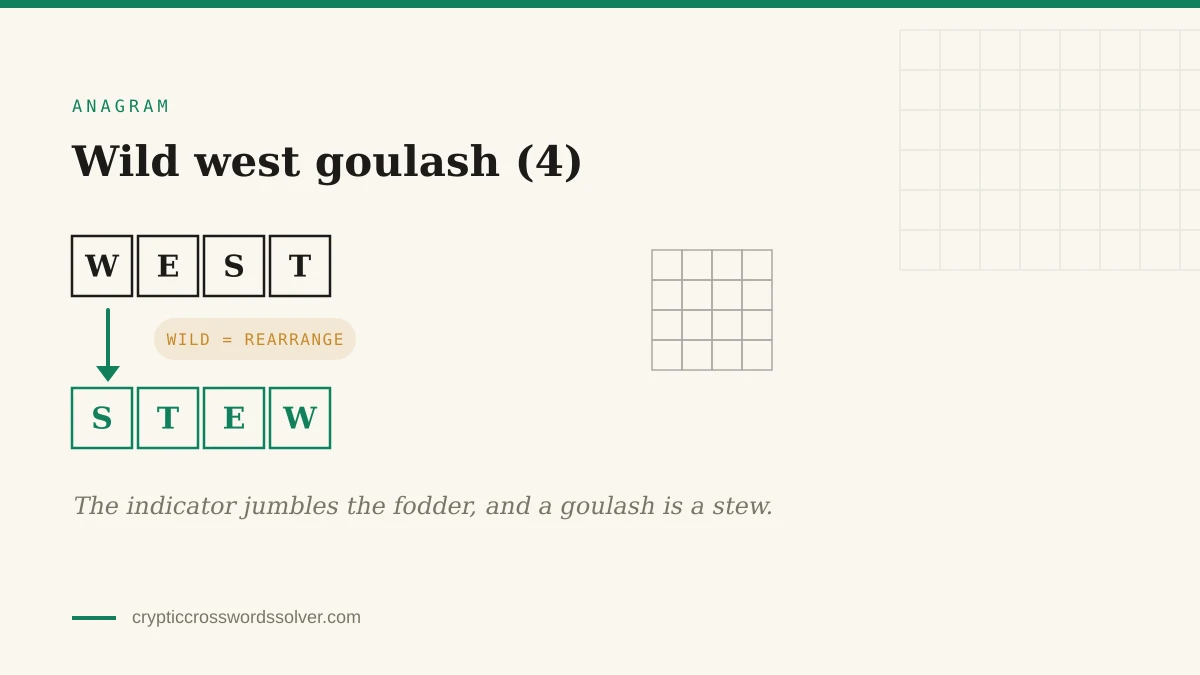
Anagram clues take a set of letters and scramble them into a new word. The clue contains an anagram indicator, a word suggesting disorder or change such as "mixed", "broken", "confused" or "twisted", sitting right next to the letters that need rearranging. Spot the indicator, identify the letters it is pointing at, and rearrange them to match the definition elsewhere in the clue.
Wild west goulash (4)
"Goulash" is the definition. "Wild" is the anagram indicator. "West" is the
fodder, four letters, matching the (4). Rearranged, W-E-S-T gives STEW.
Pattern 2: answers hidden inside words (spot-the-answer clues)
Hidden word clues bury the answer in plain sight, spread across consecutive letters in a phrase. The clue usually signals this with words like "inside", "within", "part of" or "held by". The trick is to ignore word boundaries completely and scan the running string of letters for your answer hiding in the middle.
Beer served in village restaurant (5)
Run the letters together, ignoring the spaces: vilLAGERestaurant. LAGER sits across the join between "village" and "restaurant", and it means beer.
Pattern 3: letter-extraction clues (first, last and every other letter)
These clues build an answer by pulling specific letters: the first letter of each word, the last letter, or every other letter in a phrase. Indicator phrases like "initially", "to begin", "finally" or "alternately" tip you off to which letters to extract and from where.
Initially, Scientists Help Our Wildlife put on a display (4)
"Display" is the definition. "Initially" tells you to take first letters only. Scientists, Help, Our, Wildlife give S, H, O, W, spelling SHOW.
Pattern 4: twin-meaning clues (no wordplay needed)
Double definition clues skip wordplay entirely. Instead, they give you two separate definitions, back to back, that both point to the same word. There is no trickery to decode here, just two ways of describing one answer, which makes these clues a great entry point for beginners.
Dog's cry, tree's outer layer (4)
A dog's cry is a BARK, and a tree's outer layer is also BARK. Both meanings are genuine dictionary senses of the same word.
Pattern 5: sound-alike clues (how words trick your ears)
Homophone clues use a word or phrase that sounds like the answer when spoken aloud, paired with an indicator like "sounds like", "we hear" or "reportedly". These clues reward reading the clue out loud, since the trick lives in pronunciation, not spelling.
Uncovered bear, reportedly (4)
"Uncovered" is the definition. "Reportedly" is the homophone indicator. BEAR and BARE are pronounced identically, and bare means uncovered.
Pattern 6: word-building clues (puzzle piece method)
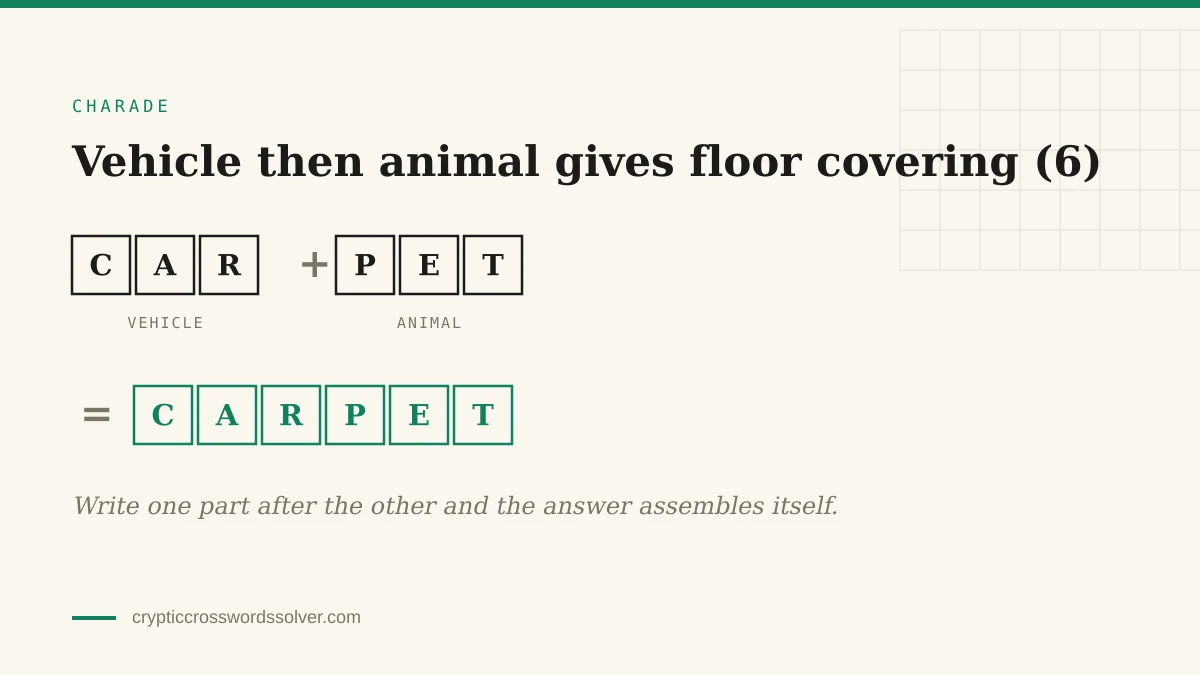
Charade clues build the answer piece by piece, joining together smaller words or abbreviations end to end, like puzzle pieces snapping into a line. Each fragment usually has its own mini-clue inside the larger clue, and once you stack them in order, you get the full answer.
Vehicle then animal gives floor covering (6)
"Floor covering" is the definition. "Then" is the charade indicator: build the answer by writing one part after another. Vehicle gives CAR, animal gives PET, and CAR + PET = CARPET.
Pattern 7: phrasal verb clues (same word, different meaning)
These clues lean on a word that has two very different meanings, often one being the everyday meaning and one being a more obscure or specialised meaning. The setter quietly uses the lesser-known meaning to point to the answer, while your brain instinctively reaches for the common one first. "Flower" doubling as "a thing that flows" (a river) is the classic case, and it is worth watching for every time a clue mentions plants, weather or everyday objects.
Pattern 8: word-inside-word clues (container technique)
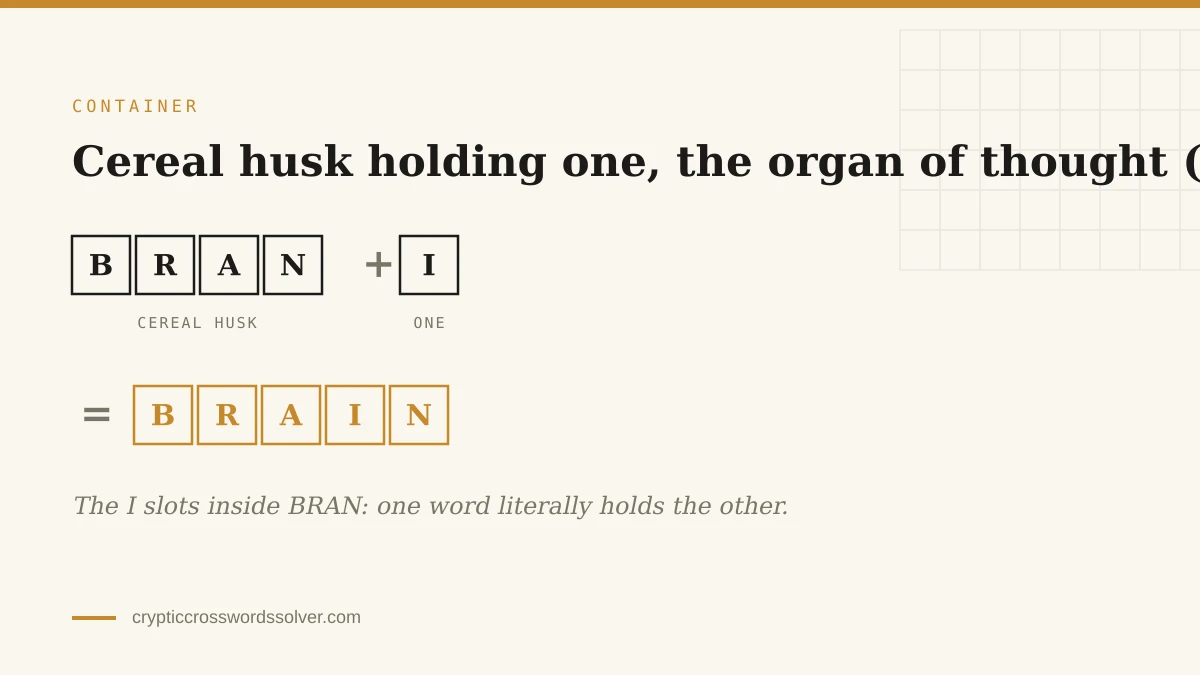
Container clues hide one word inside another, with one word literally containing the letters of a smaller word. Indicators like "inside", "within", "holding" or "surrounding" tell you that one fragment needs to be inserted into another to form the final answer.
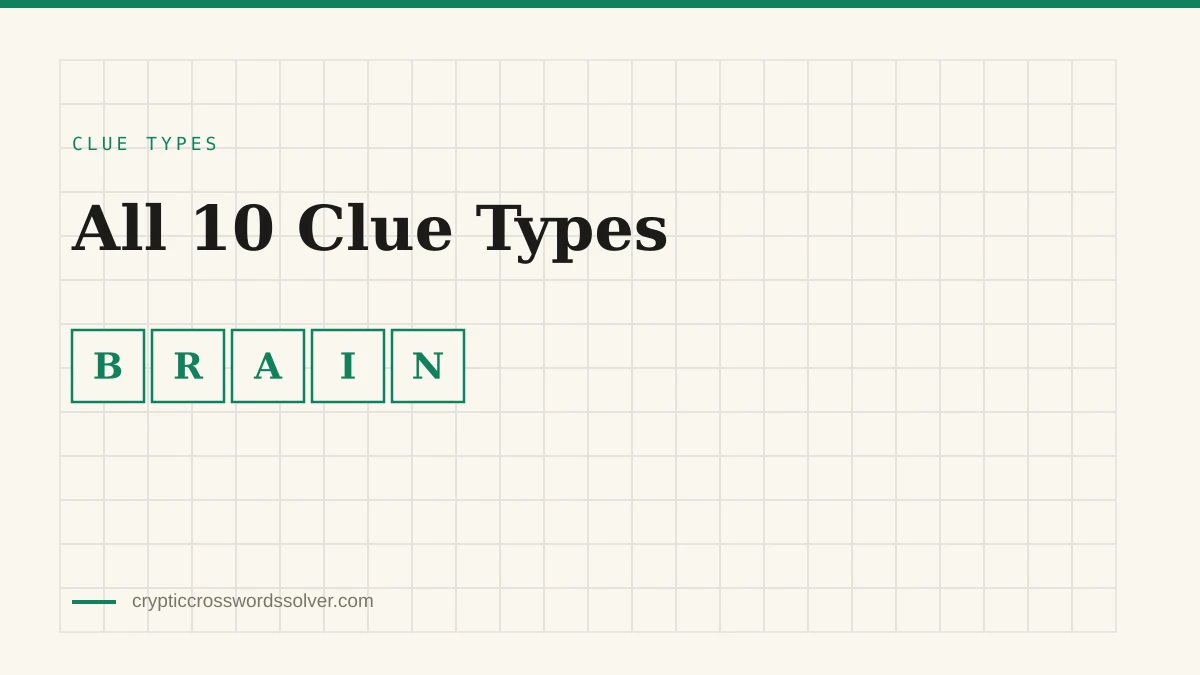
Cereal husk holding one, the organ of thought (5)
"The organ of thought" is the definition. "Holding" is the container indicator. Cereal husk gives BRAN, and "one" gives I, the Roman numeral. Put I inside BRAN and you get BRA-I-N: BRAIN.
Pattern 9: letter removal clues (cut, drop or remove letters)
Deletion clues take a longer word and remove a specific letter or chunk of letters from the front, back or middle to reveal the answer. Indicator words like "without", "losing", "headless" or "endless" point to what is being removed and from where.
Loaf loses its head, peruse what's left (4)
"Peruse" is the definition. "Loses its head" is the deletion indicator: drop the first letter. Loaf gives BREAD; remove the B and you are left with READ, which means peruse.
Pattern 10: reverse direction clues (backwards word tricks)
Reversal clues spell the answer by reading another word backwards, often signalled in across clues by words like "returning", "reversed" or "back", and in down clues by words like "rising" or "climbing", since the direction of the grid matters here.
Beer sent back is splendid (5)
"Splendid" is the definition. "Sent back" is the reversal indicator. Beer gives LAGER, and LAGER written backwards is REGAL, which means splendid.
Rare but important trick clue types you should know
Beyond the ten core patterns, a handful of rarer trick types show up often enough that you should recognise them on sight, even if they do not appear in every puzzle.
Spoonerisms: when sounds swap places
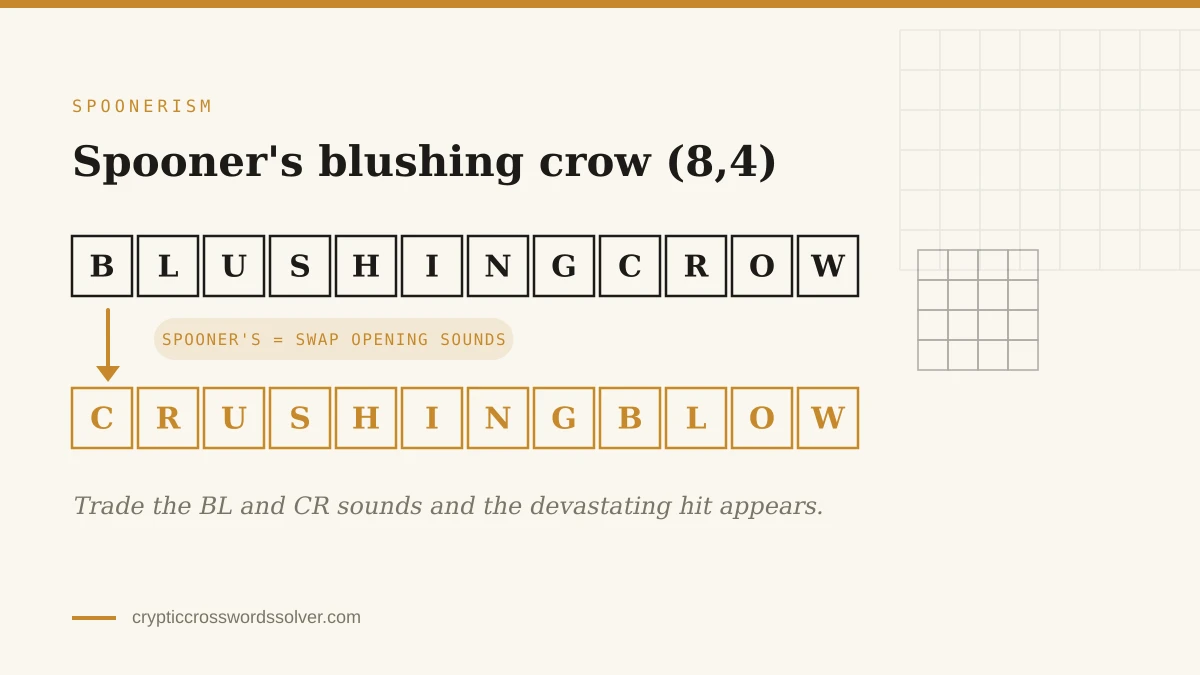
Spoonerism clues swap the starting sounds of two words to create a new phrase that sounds like the answer, playing on the same kind of slip-of-the-tongue humour the technique is named after.
Spooner's blushing crow, a devastating hit (8,4)
"A devastating hit" is the definition. "Spooner's" tells you to swap the opening
sounds of the two words that follow. Swap the BL- and CR- of "blushing crow" and
you get "crushing blow", eight letters then four, matching the (8,4).
Cryptic definition clues: pure riddles in one line
Cryptic definitions skip a separate wordplay section entirely and instead present the whole clue as a single, riddle-like description of the answer, relying on wit and misdirection rather than letter manipulation.
Repetition and substitution tricks explained
Some clues rely on a word standing in for a single repeated letter, a Roman numeral or a common abbreviation, asking you to substitute that hidden value into the rest of the wordplay before the answer falls into place. The full abbreviations reference covers every code worth knowing.
The step-by-step method to crack any cryptic clue
With the patterns in hand, the real skill is having a repeatable process for approaching any clue, instead of staring at it hoping for inspiration. The complete beginner's guide walks through this method step by step with fully worked examples.
How to spot the definition in seconds
Check the very start and the very end of the clue first, since the definition almost always lives at one of those two edges. Read each edge as a standalone synonym and see which one feels like a clean, dictionary-style match.
Finding indicator words without guessing
Once the definition is set aside, scan the remaining words for indicator language: terms suggesting mixing, hiding, removing, reversing, or sounding like something. These indicator words are your map to which of the ten patterns the wordplay is using.
Verifying answers the right way
Never lock in an answer just because it fits the definition. Walk back through the wordplay and confirm every letter is accounted for by the indicator and the fragments in the clue. If the wordplay does not fully check out, the answer is not finished yet.
How beginners can improve fast, without memorising everything
You do not need to memorise hundreds of indicator words overnight. Steady, structured practice beats memorisation every time.
Start with the easiest clue types first
Begin with double definitions and simple anagrams, since they require the least specialised knowledge and build your confidence quickly before moving on to trickier container and deletion clues.
Build confidence using pattern recognition
Keep a running list of indicator words you encounter, grouped by clue type, and review it after each puzzle. Over time, your brain starts recognising patterns automatically, the same way a chess player starts recognising openings, and the clues that once felt impossible start to feel almost obvious.
Frequently asked questions
How many clue types are there in a cryptic crossword? There are ten main clue types in cryptic crosswords: anagrams, hidden words, letter-extraction clues, double definitions, homophones, charades, phrasal-verb clues, containers, deletions and reversals. A few rarer types, such as spoonerisms and cryptic definitions, round out the toolbox.
Which clue type is easiest for beginners? Hidden word clues and double definition clues are usually the easiest to solve. Hidden word clues are simple because the answer is already inside the clue. Double definition clues use two meanings for the same answer.
How do I know where the definition ends and the wordplay begins? The definition is always at the beginning or the end of the clue. It is never in the middle. Look for indicator words that give instructions, and the remaining part is usually the definition.
What are the most important indicator words to learn first? Start with the words used in anagrams, hidden words and reversals.
- Anagram: mixed, confused, broken, wild
- Hidden word: in, within, part of, found in
- Reversal: back, returned, up
Can one clue use more than one clue type? Yes. Some clues combine more than one clue type together. A clue may ask you to remove a letter and then reverse the word. Harder puzzles often layer clue types this way.
What does a question mark at the end of a cryptic clue mean? A question mark usually means there is a trick or unusual meaning in the clue. It tells you not to read the clue in a normal way, and it is often used when the clue is a small riddle.
Conclusion
Cryptic crosswords may look hard at first, but they become easier once you learn the basic rules. Every clue follows a pattern, and once you know the clue types and indicator words, solving becomes much simpler.
Use this method: find the definition, look for the indicator word, identify the clue type, and check that the answer fits both parts of the clue.
Do not worry if you cannot solve every clue right away. Practice helps you recognise patterns faster. The more puzzles you solve, the easier they become. Keep learning, keep solving, and cryptic crosswords will feel less confusing and much more fun. Visit the homepage for the full guide and a free solver to test yourself against.