How to Solve Cryptic Crosswords: The Complete Beginner's Guide
Every cryptic clue type, the indicator words that flag each one, and a step-by-step method that works on any clue, all illustrated with examples that genuinely check out.
Cryptic crosswords look impossible the first time you see them. You read a clue like "Wild west goulash (4)" and nothing makes sense. It reads like a sentence, but it does not mean anything obvious. You try again. Still nothing.
Here is what nobody tells beginners: you do not need more knowledge. You need to learn a code. Cryptic crosswords are about code-breaking. The surface reading of a clue is deliberately misleading, so stop reading clues as sentences and focus on their structural components instead.
Once you know the code, the small set of rules that governs every cryptic clue, those same impossible-looking puzzles start to unlock themselves with real, satisfying logic. This Cryptic Crossword Solver guide teaches the entire code from scratch: every clue type, every indicator word, and a step-by-step solving method that works on any clue.
What is a cryptic crossword, and how is it different?
Before solving cryptic crosswords, it helps to understand what makes them work differently from regular crosswords.
Regular crosswords vs cryptic crosswords
In a regular crossword, each clue is a straightforward definition. "Capital of France (5)" means you need a five-letter word that is the capital of France. The answer is PARIS. That is the whole clue.
Cryptic crosswords work differently. Every cryptic clue gives you the answer twice: once through a direct definition, and once through wordplay. Both parts point to the same answer. When you solve a cryptic clue correctly, you will have confirmed the answer two separate ways. If only one path works, you have the wrong answer or have misidentified the clue type.
The golden rule: every cryptic clue has two parts
Every cryptic clue divides into two pieces sitting side by side, plus nothing else:
- The definition. A direct synonym or description of the answer. It always sits at the very beginning or very end of the clue, never in the middle.
- The wordplay. A coded instruction for how to construct the answer letter by letter. This fills the rest of the clue.
The answer is the word that satisfies both parts simultaneously. This double confirmation is what makes cryptic crosswords fair. There is only one answer that satisfies both the definition and the wordplay: if a candidate only fits one, keep looking.
Why cryptic clues sound like normal sentences
Setters write cryptic clues so the definition and wordplay together read like a natural English sentence, using misdirection to encourage the solver to look in the wrong place. Each clue is a miniature piece of creative writing containing both wordplay and a definition of the answer, and the challenge for the solver is to figure out which is which and why.
The surface reading, what the clue appears to say, is a decoy. Your job is to look through the surface meaning and find the hidden structure underneath.
The 9 cryptic crossword clue types, with verified examples
There are nine main wordplay devices used in cryptics: anagrams, hidden words, double definitions, reversals, charades, containers, homophones, deletions and cryptic definitions. Every example below has been checked letter by letter, so the mechanics genuinely hold up. For the ten-pattern version of this map, with a few extra rare tricks folded in, see the cryptic crossword clue types guide.
Clue type 1: anagram
In an anagram, the letters of one or more words are rearranged to form another word or phrase. Spot the type by identifying the anagram indicator, a word that implies change, disarray or confusion, sitting beside the fodder, the letters to be rearranged.
Common anagram indicators: mixed, confused, broken, strange, unusual, wild, drunk, upset, rearranged, reformed, twisted, shattered, disordered, muddled, scrambled, novel, free, excited, crazy, bats, bananas, wrong, awry, somehow, possibly, alternatively, changed, different, cooked, doctored, tossed, tipsy, pitching, nuts, crackers.
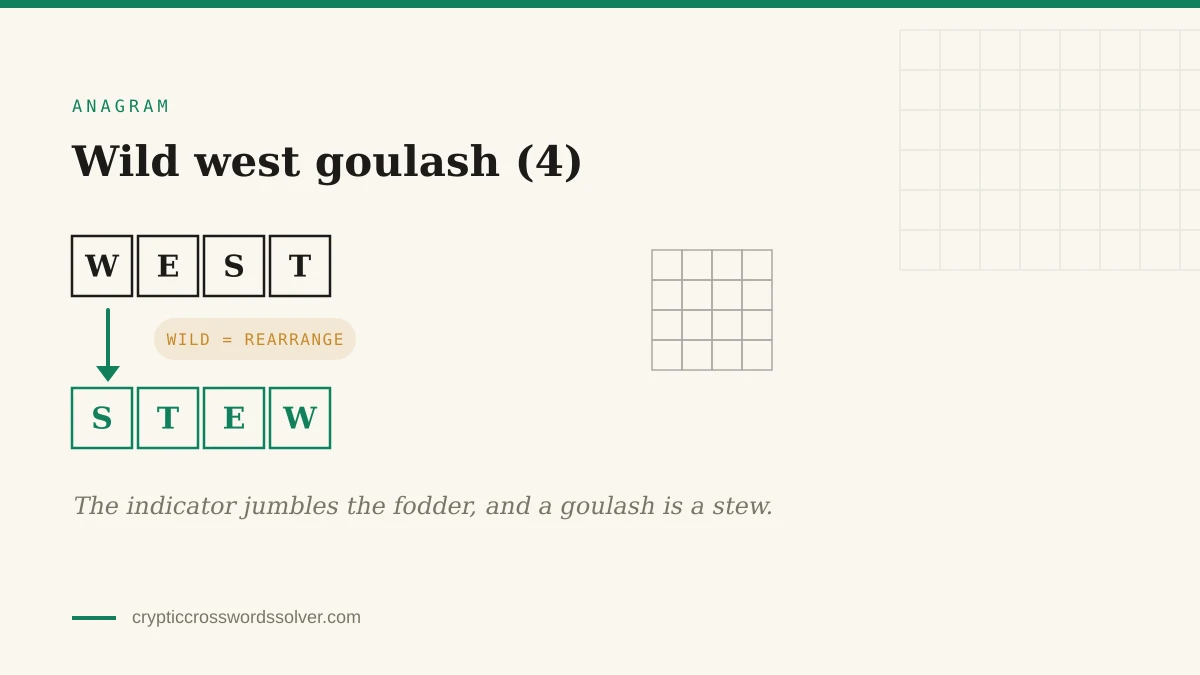
Wild west goulash (4)
"Goulash" is the definition. "Wild" is the anagram indicator. "West" is the
fodder: four letters, matching the (4). Rearranged, W-E-S-T gives STEW.
Attend to broken silent (6)
"Attend to" is the definition, "broken" is the indicator, and "silent" is the
fodder: six letters, matching the (6). S-I-L-E-N-T rearranges to LISTEN.
Key tip: count the letters in the suspected fodder before doing anything else. If they match the answer length, you almost certainly have an anagram clue.
Clue type 2: hidden word
In a hidden word clue, the answer is spelled out consecutively inside the clue text itself, hidden across the letters of one or more words. The answer is already there in order; you just need to find where it starts and ends.
Hidden word indicator words: in, within, inside, part of, some, some of, bit of, portion of, held by, found in, seen in, contains, conceals, hides.
Annual, seen inside the cathedral very early (6)
"Annual" is the definition. "Seen inside" flags the hidden word. Run the rest of the clue together, ignoring the spaces: thecathedralveryearly. YEARLY sits across the break between "very" and "early", and it means annual.
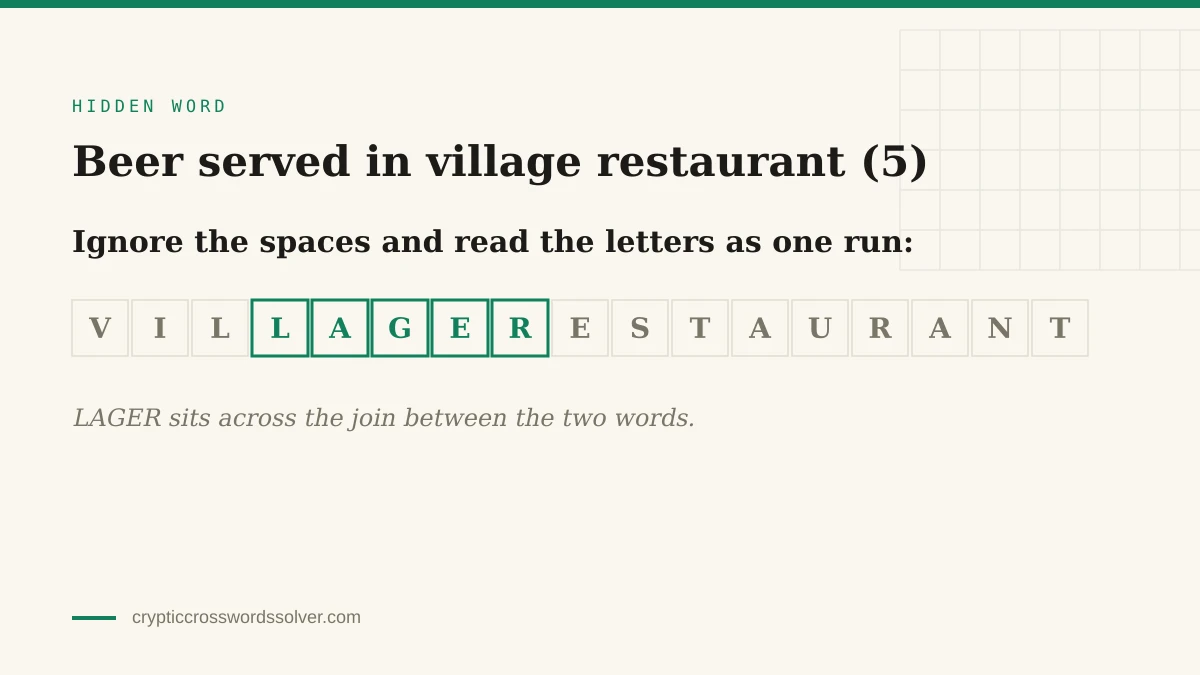
Beer served in village restaurant (5)
"Beer" is the definition and "served in" signals the hidden word. Run the letters together: villagerestaurant. LAGER straddles the join between "village" and "restaurant".
Key tip: once you spot a hidden word indicator, run your eye along every consecutive set of letters in the clue. The answer will appear unbroken, across the boundary of one or more words, never sitting inside a single word alone.
Clue type 3: double definition
A double definition clue contains two separate definitions of the same word placed side by side. Each definition independently leads to the same answer. There is no indicator word and no letter manipulation.
Dog's cry, tree's outer layer (4)
A dog's cry is a BARK, and a tree's outer layer is also BARK. Both meanings are genuine dictionary senses of the same word.
Flying mammal's club (3)
A BAT is a flying mammal, and a bat is also a club used to strike a ball.
Key tip: when you see a very short clue with no indicator words, ask yourself whether the word could mean two completely different things that both point to the same answer. If yes, you have a double definition.
Clue type 4: reversal
A reversal clue tells you to reverse a word in the clue to produce the answer. The clue always contains a reversal indicator showing that the letters need to be read backwards.
For across clues: back, backwards, returned, reversed, reflected, retreating, recalled, going back, turned. For down clues: up, rising, climbing, ascending, going up, mounting, northward, since reading a down entry upward is reading it backwards.
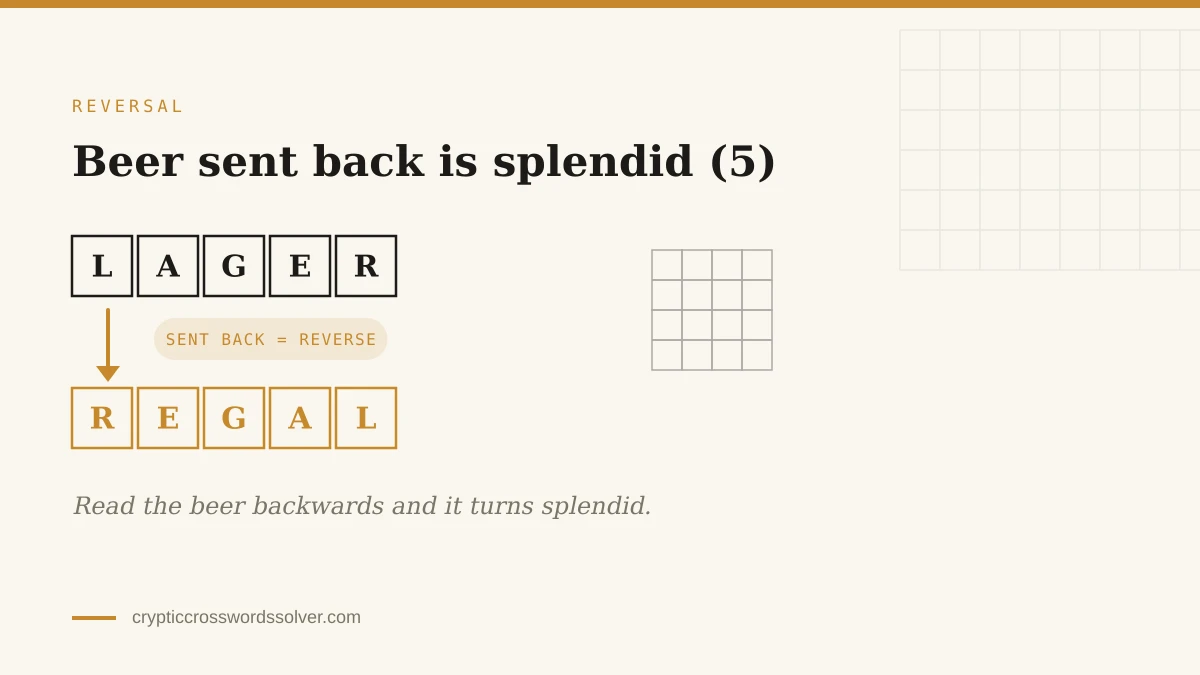
Beer sent back is splendid (5)
"Splendid" is the definition. "Sent back" is the reversal indicator. Beer gives LAGER, and LAGER written backwards is REGAL, which means splendid.
Storage compartment sent back as a prize (6)
"A prize" is the definition. Storage compartment gives DRAWER, and DRAWER written backwards is REWARD.
Key tip: in down clues, "up", "rising" and "climbing" are the most common reversal signals. In across clues, look for "back", "returned" and "reversed".
Clue type 5: charade
In a charade, the answer is formed by joining two or more words together. Each part of the clue leads to a portion of the answer, and the portions are assembled in order, like the word game charades.
Connective words like "and", "with", "after", "then" and "followed by" often appear between sections, and common abbreviations are heavily used: DR or MB for doctor, ER for the Queen (Elizabeth Regina), R or K for king, ST for saint, N, S, E, W for the compass points, O for ring or zero, and the Roman numerals I, V, X and C.
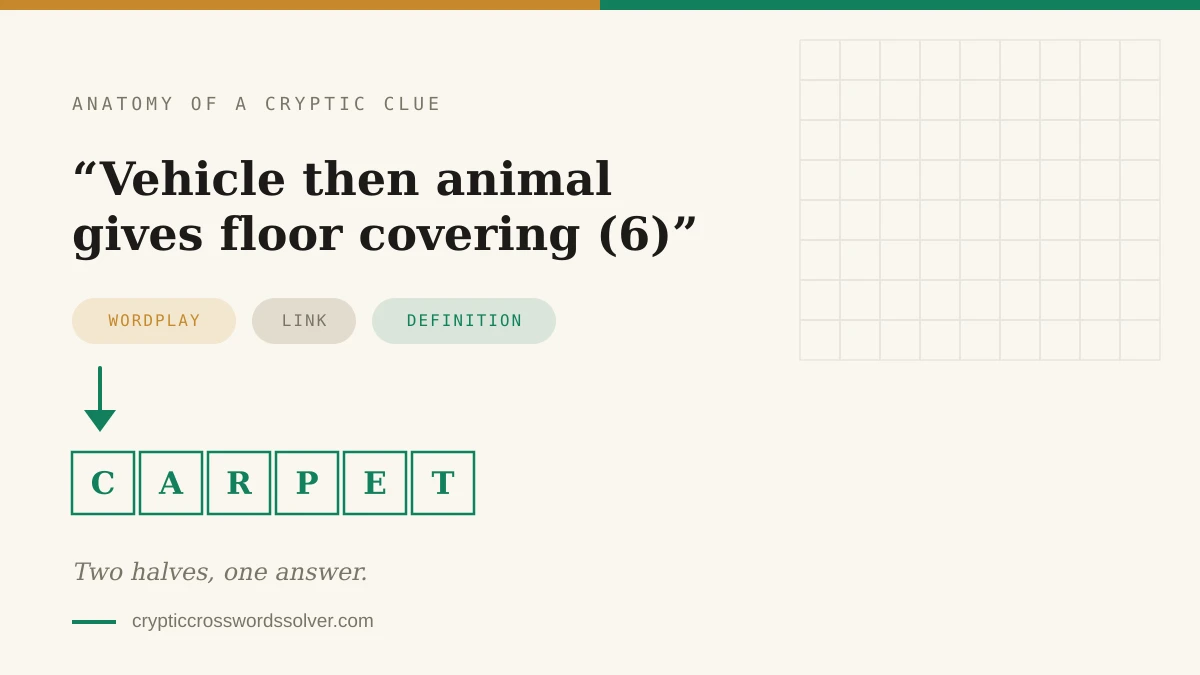
Vehicle then animal gives floor covering (6)
"Floor covering" is the definition. "Then" is the charade indicator: build the answer by writing one part after another. Vehicle gives CAR, animal gives PET, and CAR + PET = CARPET.
Came across the Queen, a measuring device (5)
"A measuring device" is the definition. "Came across" is the past tense of meet, giving MET. "The Queen" gives ER, from the royal cipher Elizabeth Regina. MET + ER = METER.
Key tip: when a clue breaks naturally into two parts, especially when you spot compass directions, Roman numerals, royalty or professional titles, think charade and assemble the parts from left to right. The complete abbreviations reference covers the full list.
Clue type 6: container
A container clue places one set of letters inside another. Signalled by indicators like "in", "around", "holding" or "containing", one element goes inside another and the result is the answer.
Container indicator words: around, surrounding, embracing, enveloping, holding, carrying, inside, in, within, containing, filled with, swallows, devours, absorbs, takes in, about, keeps, houses.
Cereal husk holding one, the organ of thought (5)
"The organ of thought" is the definition. "Holding" is the container indicator. Cereal husk gives BRAN, and "one" gives I, the Roman numeral. Put I inside BRAN and you get BRA-I-N: BRAIN.
Key tip: after solving a container clue, verify by looking at the answer. You should be able to see one word physically sitting inside another, split by the inserted letters on both sides.
Clue type 7: homophone
A homophone clue tells you the answer sounds like another word in the clue. The two words are homophones: same pronunciation, different spelling and meaning. The clue contains a sound indicator telling you to use your ears rather than your eyes.
Homophone indicator words: we hear, I hear, they say, so we're told, reportedly, apparently, sounds like, aloud, out loud, spoken, vocal, verbal, on the radio, broadcast, say, said, announced, declared, uttered, for listeners.
Uncovered bear, reportedly (4)
"Uncovered" is the definition. "Reportedly" is the homophone indicator. BEAR and BARE are pronounced identically, and bare means uncovered.
Flower, we hear, used in baking (5)
"Used in baking" is the definition. "We hear" is the homophone indicator. FLOWER and FLOUR sound the same aloud, and flour is what you bake with.
Key tip: homophone clues are among the rarer types but the easiest to spot. The moment you see a sound-related indicator, think of words in the clue that sound like possible answers.
Clue type 8: deletion
A deletion clue removes one or more letters from a word in the clue to produce the answer. A word may lose its head (first letter), heart (a central letter) or tail (last letter).
- Beheadment, remove the first letter: headless, beheaded, loses its head, without a leader, not a starter, decapitated.
- Curtailment, remove the last letter: most of, almost, nearly, not quite, endless, endlessly, cut short, curtailed, briefly.
- Gutting, remove middle letters: heartless, hollow, empty, vacant.
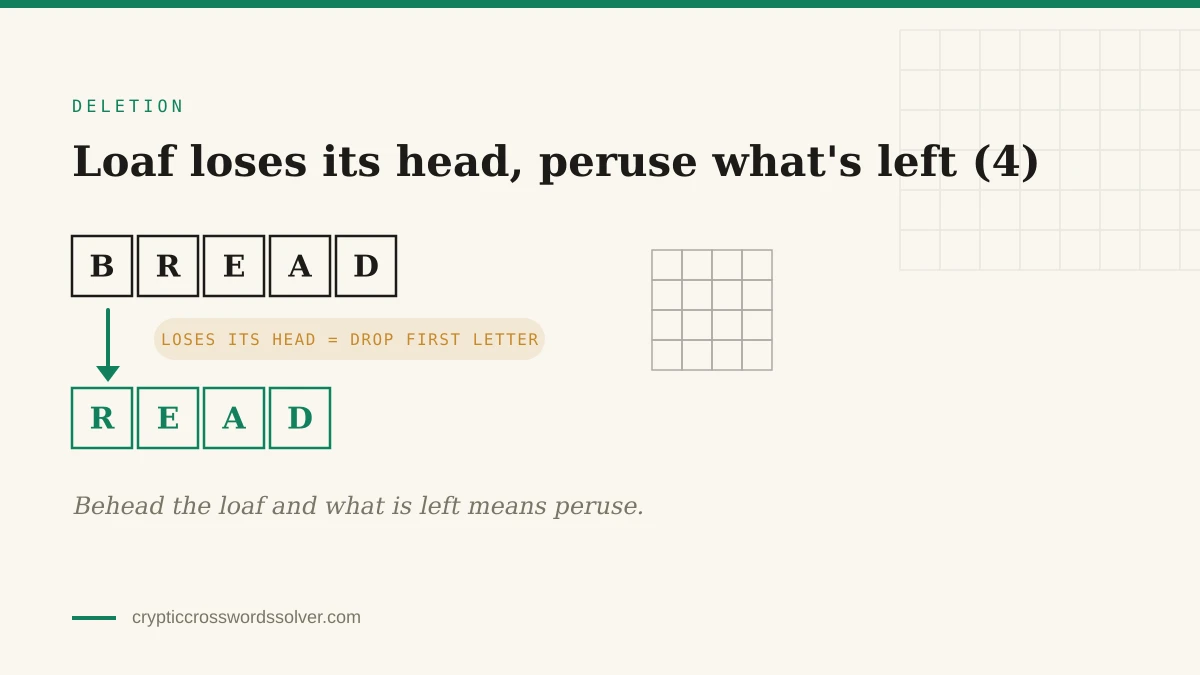
Loaf loses its head, peruse what's left (4)
"Peruse" is the definition. "Loses its head" is the deletion indicator: drop the first letter. Loaf gives BREAD; remove the B and you are left with READ, which means peruse.
Headless fright is a concern (4)
"A concern" is the definition. Fright gives SCARE; remove the first letter S and you are left with CARE, which means a concern.
Key tip: "most of" and "almost" almost always signal curtailment, the last letter removed. "Headless" or "beheaded" signals the first letter removed. Check these signals first, then work out which word to delete from.
Clue type 9: cryptic definition
Cryptic definition clues do not use indicator words, though they are often flagged with a question mark or exclamation mark. The entire clue is a riddle or a piece of lateral thinking. There is no separate wordplay and definition: the whole clue is a witty, indirect description of the answer, so it can only be checked by reasoning it through, not by decomposing letters.
I leave silver behind me wherever I travel (5)
A snail leaves a silvery trail. SNAIL has five letters, matching the (5).
Flower running through France (5)
"Flower" is not a bloom here; it is something that flows, a river. The River
SEINE runs through France, five letters, matching the (5).
Famous cryptic misdirection words worth learning: flower (a river, something that flows), number (an anaesthetic, something that numbs), jumper (a sweater, or something that jumps), driver (a golf club, or one who drives), vessel (a ship, bowl or blood vessel), issue (children, a magazine, or to send out), charge (a fee, an accusation or an attack), tender (soft, a boat, or to offer), swallow (a bird, or to consume).
Key tip: when a short clue has a question mark at the end and no indicator words, read it as a riddle. Ask yourself what else each word in the clue could mean, and what object or concept is being described sideways.
Cryptic crossword indicator words: master reference
Spotting indicator words is the fastest skill you can develop as a beginner. Here is a consolidated reference of the most important indicators, grouped by clue type.
Anagram indicators
abstract, absurd, active, addled, adjusted, afresh, after a fashion, alloy, all at sea, alien, altered, alternative, amazing, anyway, askew, awkward, awry, bad, baffling, bats, bananas, bizarre, broken, chaotic, changed, confused, convoluted, cooked, crazy, crumbling, damaged, different, disordered, disturbed, doctored, drunk, excited, extraordinary, flustered, fractured, free, jumbled, loose, mangled, messy, mixed, muddled, new, novel, nuts, odd, peculiar, possibly, random, rearranged, rebuilt, reformed, remodelled, scrambled, shattered, shifted, somehow, strange, tipsy, transformed, twisted, unusual, upset, weird, wild, wrecked, wrong.
Hidden word indicators
bit of, contains, found in, has, hides, held by, in, inside, is in, part of, portion of, section of, some, some of, within, seen in, conceals.
Reversal indicators
Across clues: about, back, backwards, coming back, going back, in reverse, recalled, reflected, retreating, returned, reversed, turned.
Down clues: ascending, climbing, coming up, going up, mounting, rising, up, upward, northward.
Container indicators
about, absorbs, around, carries, clutches, contains, devours, embraces, envelops, goes around, has, holds, housing, in, inside, keeping, possesses, surrounds, swallows, takes in, wearing, within.
Homophone indicators
aloud, announced, broadcast, declared, for listeners, heard, I hear, in speech, on the radio, out loud, reportedly, said, say, sounds like, they say, to listeners, uttered, verbally, vocal, we hear.
Deletion indicators
Beheadment: beheaded, headless, loses its leader, not a starter, without a head, without its beginning, decapitated.
Curtailment: almost, briefly, curtailed, endless, endlessly, finished, incomplete, most of, nearly, not quite, short of, without an end, cut short.
Gutting: heartless, hollow, empty, vacant.
Common abbreviations in cryptic crosswords: quick reference
Abbreviations turn up constantly, especially inside charade and container clues. The best way to learn them is to solve real puzzles and pick them up through repetition, but a handful are worth committing to memory right away.
People, titles and roles: Doctor is DR, MB, MD or GP. Saint is ST. Queen Elizabeth is ER. King is R, K or REX. Mister is MR. Church of England is CE. Old Testament is OT, New Testament is NT.
Directions and positions: North, South, East and West are N, S, E, W. Right is R, Left is L. "First" or "initially" points to the first letter of the next word, and "last" or "finally" points to the last letter.
Numbers, symbols and common words: One is I, Five is V, Ten is X, Fifty is L, Hundred is C, Thousand is M. Ring, love, zero, egg or circle is O. About or approximately is C, from the Latin circa. Street is ST, Road is RD, River is R.
Musical notes: DO, RE, MI, FA, SOL, LA and TI can all appear in a charade clue where "note" is the indicator.
The full A to Z reference covers every level from beginner to expert, including the rarer setter-specific shorthand.
How to solve any cryptic clue: step-by-step strategy
Now that you know all nine clue types and the indicator words, here is the exact process to apply to every clue.
- Note the answer length. Always look at the number in brackets first. This is particularly useful for anagrams: if you suspect the clue contains one, looking for a word or words that together match the answer length helps you find the fodder. The same applies to every clue type.
- Read the clue twice. Read it once for the surface meaning, then set that completely aside. Read it again analytically, looking at each word as a potential code element rather than part of a meaningful sentence.
- Find the definition at one end. The definition is always at the start or end of the clue, never in the middle. Try both ends: could the first word or words be a direct synonym for a possible answer? Could the last?
- Scan for indicator words. Run through the middle of the clue looking for any indicator word you recognise. Spotted an anagram indicator? Look for fodder matching the answer length. Spotted a reversal indicator? Look for a word that reversed gives the answer. Spotted a hidden word indicator? Trace the consecutive letters.
- Test the answer against both parts. Once you have a candidate, verify it against both the definition and the wordplay. The correct answer must satisfy both. If a word matches the wordplay but is not a synonym of the definition, or vice versa, keep looking.
- Use crossing letters from the grid. Just like regular crosswords, use the letters you have already filled in from other clues to help solve the remaining ones. A single crossing letter can confirm which of two anagram solutions is correct, or help you identify a hidden word.
- Move on and come back. Don't get discouraged if you can't solve many clues at first. If a clue isn't yielding after a few minutes, move on. A clue that was opaque with zero crossing letters often becomes obvious with just two or three confirmed.
Beginner tips for solving cryptic crosswords
- Start with hidden words and double definitions. Anagrams and hidden words are generally the easiest for beginners to spot. Double definitions are also quick wins: they're short, have no indicator words, and rely purely on knowing two meanings of the same word.
- Ignore punctuation in the middle of clues. You can generally ignore punctuation in a clue; it is mostly there to mislead you. The one exception is a question mark or exclamation mark at the end of a clue, which often signals a cryptic definition.
- Remember that flowers are rivers. Learn the classic cryptic misdirection words. A flower is a river. A number is an anaesthetic. A jumper is a sweater. A single word can have several genuine meanings, and setters exploit that constantly.
- Learn the most common abbreviations first. You don't need to memorise hundreds at once. Start with the ten most common: ER, DR, ST, N, S, E, W, R, O and the Roman numerals I, V, X. These appear in almost every cryptic crossword.
- Start with beginner-friendly puzzles. The Guardian's Quiptic crossword is specifically designed for beginners. The Times Concise Cryptic and the Financial Times Falcon cryptic are also fair, consistent starting points. Do not attempt expert-level cryptics first; the difficulty gap is enormous. Once the basics click, the Daily Telegraph cryptic crossword is a natural next step up.
- Solve in pencil and keep a cheat sheet handy. You will correct answers along the way. When starting out, keep a reference of indicator words and common abbreviations next to the puzzle.
- Verify every answer in both directions. Never accept an answer that only satisfies one half of the clue. If the wordplay gives you METER and the definition says "measuring device", both confirm it. If only the definition fits and the wordplay does not, you have the wrong answer or the wrong clue type.
Frequently asked questions
What is the golden rule of every cryptic clue? Every cryptic clue has two parts: a definition and a wordplay puzzle. The definition gives the meaning of the answer, and the wordplay helps you find it. The answer must match both parts.
How many clue types are there in cryptic crosswords? There are nine main clue types: anagrams, hidden words, double definitions, reversals, charades, containers, homophones, deletions and cryptic definitions.
Which clue type is easiest for beginners? Hidden word clues are usually the easiest for beginners, since the answer is already inside the clue and you only need to find it.
What are the most common anagram indicator words? Common examples are changed, mixed, unusual, wrong, crazy, nuts and different.
How do I find the definition in a cryptic clue? The definition is usually at the beginning or the end of the clue. First look for indicator words that reveal the wordplay, then check the remaining end for the meaning.
What does a question mark at the end of a clue mean? It means the clue may have a trick, joke or unusual meaning, so do not read every word in the normal way.
Are cryptic crosswords only for experts? No. Anyone can learn cryptic crosswords, and with practice the rules become easier to understand.
What is the best cryptic crossword for a complete beginner? The Guardian's Quiptic is a good choice because it uses simple, fair clues. The Times Mini Cryptic is also a good option.
Quick summary: all 9 clue types at a glance
| Clue type | What it does | Key indicator signal |
|---|---|---|
| Anagram | Letters rearranged | mixed, confused, wild, broken, strange |
| Hidden word | Answer inside clue text | in, within, part of, some, found in |
| Double definition | Two definitions side by side | short clue, no indicator |
| Reversal | Word reversed | back, returned, up (in down clues) |
| Charade | Parts built in sequence | and, with, after, followed by |
| Container | Word placed inside another | around, holds, swallows, embraces |
| Homophone | Sounds like another word | we hear, reportedly, sounds like |
| Deletion | Letters removed | most of, headless, endless |
| Cryptic definition | Whole clue is a riddle | ?, !, short lateral clue |
Conclusion
Cryptic crosswords may look hard at first, but they become easier when you learn the basic rules. Every clue follows a pattern, and once you know the clue types and indicator words, solving becomes much simpler.
Use this method: find the definition, look for the indicator word, identify the clue type, and check whether the answer fits both parts of the clue.
Do not worry if you cannot solve every clue right away. Practice helps you recognise patterns faster. The more puzzles you solve, the easier they become. Keep learning, keep solving, and cryptic crosswords will feel less confusing and much more fun. Head back to the homepage for the full toolkit, or when you are ready to test what you have learned, the free solver checks pattern matches, anagrams and hidden words right in your browser.