The Daily Telegraph Cryptic Crossword: A Complete Guide
The history, puzzle types, Toughie setters, Ximenean rules and solving method behind one of Britain's longest-running cryptic crosswords, plus where to find solutions.

The Daily Telegraph cryptic crossword is one of the most respected daily puzzles in the UK. It has run continuously since 1925 and built a loyal readership across a century of daily solving. Whether you are picking it up for the first time or looking to finally crack the harder Toughie edition, this Cryptic Crossword Solver guide covers the puzzle types, the day-by-day difficulty curve, the Toughie setter pseudonyms, the Ximenean rules that govern the clues, the best free resources for finding solutions, and a progression path from beginner to advanced solver.
A brief history of the Daily Telegraph cryptic crossword
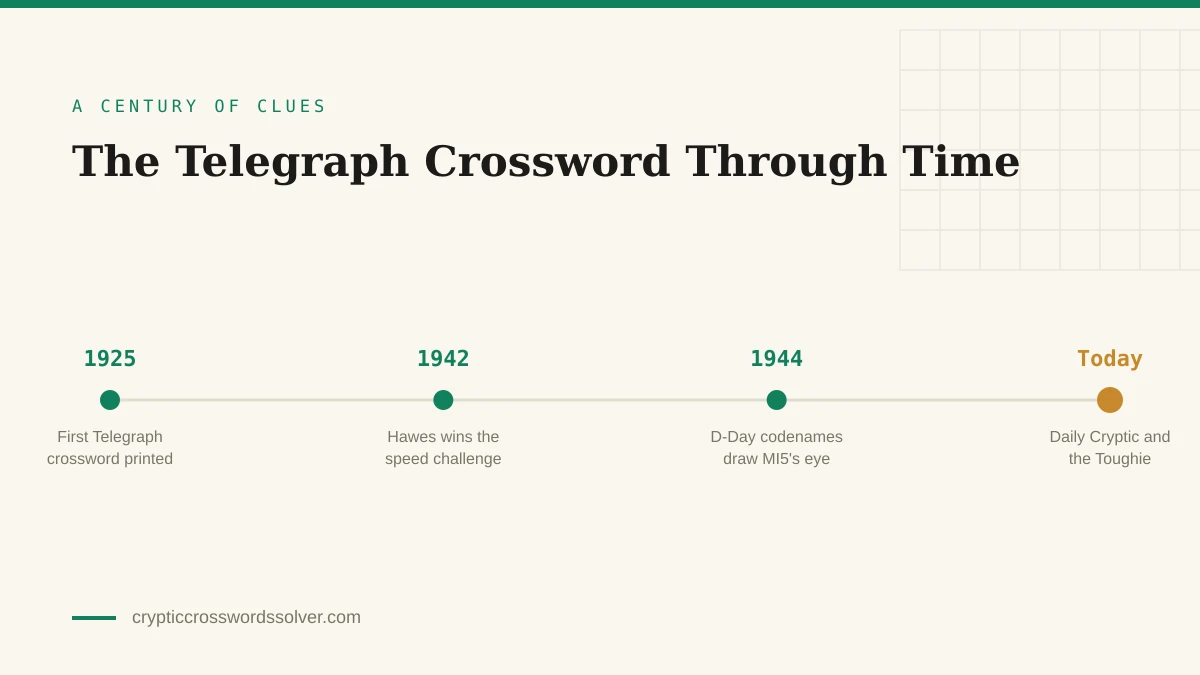
The Daily Telegraph published its first crossword in 1925, making it one of the earliest British newspapers to adopt the form. In its early years the puzzles were simple and definitional. By the late 1930s they had evolved into fully cryptic puzzles using wordplay, anagrams and hidden words, the style that remains today.
During the Second World War, the Telegraph crossword became a cultural institution. In January 1942 the paper issued a public challenge: could anyone solve the puzzle in under twelve minutes? Twenty-five people turned up at the Telegraph's offices to try. Five completed it within the deadline. The fastest was F. H. W. Hawes, who finished in seven minutes and 57.5 seconds, a remarkable feat that demonstrated how dedicated solvers had become.
In 1944 the crossword briefly attracted attention from MI5 after several D-Day operation codenames appeared in puzzles before the Normandy landings. The compiler Leonard Dawe was investigated but cleared of wrongdoing, and the incident became one of the most famous stories in crossword history.
Val Gilbert later edited the Telegraph crossword for thirty years, shaping its modern style and helping document its evolution for future solvers.
The Telegraph crossword in numbers
Roger Squires, one of its longest-serving setters, became one of the world's most prolific crossword compilers. Over his career he produced tens of thousands of puzzles and an estimated millions of clues.
A typical Telegraph cryptic contains around 28 to 30 clues. This consistent structure helps solvers develop familiarity with clue patterns and solving rhythm over time.
The Daily Telegraph crossword puzzles: what's available
The Telegraph publishes several distinct crossword puzzles across the week. Understanding which puzzle is which, and what each demands, is the first step to choosing the right one for your level.
| Feature | Daily Cryptic | The Toughie | Saturday GK Crossword |
|---|---|---|---|
| Published | Monday to Saturday | Tuesday to Friday | Saturday |
| Setter identity | Anonymous | Named pseudonym | Kate Mepham |
| Difficulty | Moderate | Hard to very hard | General knowledge focus |
| Style | Ximenean, structured clues | More inventive and playful | Mixed GK and wordplay |
| Clue count | 28 to 30 | 28 to 30 | Larger grid |
| Best for | Intermediate solvers | Advanced solvers | GK enthusiasts |
| Prize | No | No | Yes |
The Sunday Telegraph cryptic
The Sunday Telegraph features a separate cryptic crossword set by Brian Greer. It is distinct from the weekday puzzles in both style and structure. It is generally harder than the Monday Daily Cryptic, slightly easier than the toughest Toughie puzzles, and a balanced, satisfying challenge for regular solvers. Many solvers use it as a bridge puzzle between standard cryptics and advanced difficulty levels.
Difficulty by day
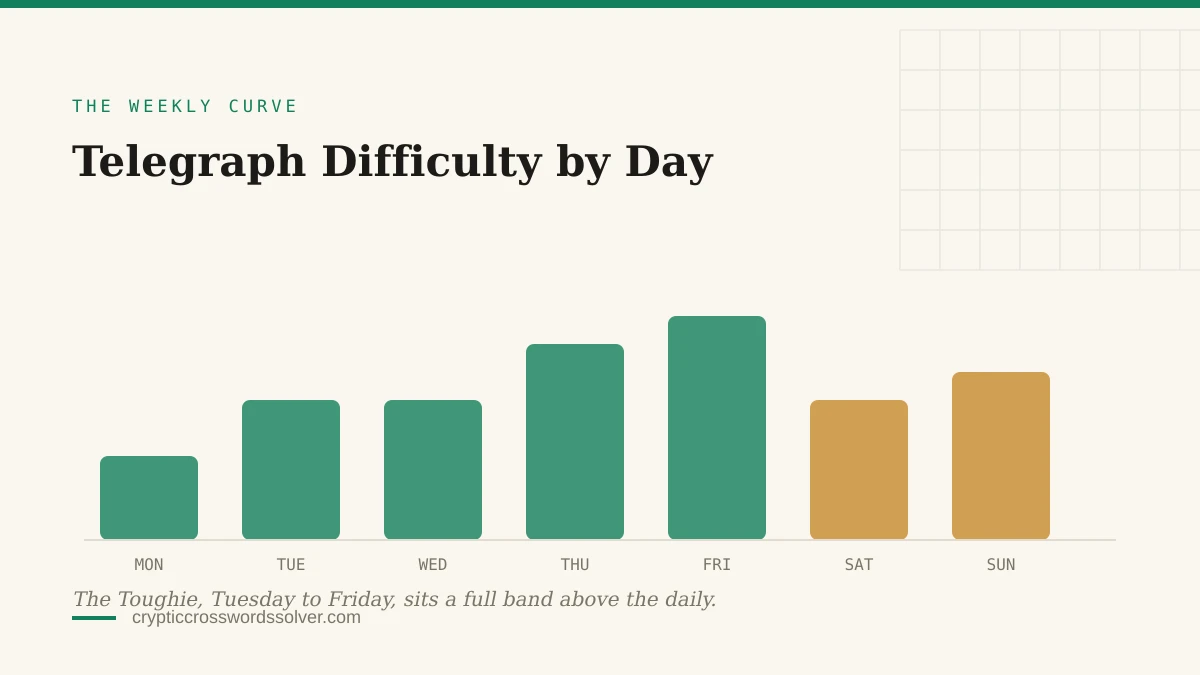
Although not officially graded, experienced solvers recognise a clear pattern of increasing difficulty through the week.
| Day | Puzzle available | Cryptic difficulty | Toughie difficulty | Notes |
|---|---|---|---|---|
| Monday | Daily Cryptic | Easy to moderate | N/A | Gentle start to the week |
| Tuesday | Daily + Toughie | Moderate | Hard | Toughie begins |
| Wednesday | Daily + Toughie | Moderate | Hard | Mid-week increase |
| Thursday | Daily + Toughie | Moderate to hard | Hard to very hard | Often the toughest day |
| Friday | Daily + Toughie | Moderate to hard | Very hard | Peak difficulty |
| Saturday | Daily + GK Prize | Moderate | N/A | General knowledge focus |
| Sunday | Sunday Cryptic | Moderate to hard | N/A | Separate puzzle system |
Toughie difficulty can vary significantly depending on the setter, with some puzzles being notably more complex than others.
The Telegraph Toughie: everything you need to know
The Toughie is the Telegraph's premium cryptic crossword, harder, more inventive and more demanding than the standard daily. It runs Tuesday through Friday and is the puzzle that serious cryptic solvers in the UK work toward. Unlike the anonymous daily cryptic, each Toughie carries the setter's pseudonym, which gives strong clues about the style and difficulty before you even start solving.
Why the Toughie is harder
- Clue surfaces are more misleading. The surface reading is carefully crafted to distract from the underlying wordplay.
- Wordplay is more complex. Clues often combine multiple techniques such as anagrams, containers, reversals and double definitions in tighter constructions.
- Definitions are more oblique. Setters frequently use less obvious or secondary meanings of common words.
- Crossing letters are less helpful. Grids are often designed to give fewer easy entry points early on.
- General knowledge elements appear. Some setters include GK references that require wider cultural awareness, though most clues are still solvable through wordplay.
Telegraph Toughie setters and their styles
Knowing the setter before you start is one of the most useful advantages in tackling a Toughie. Each setter has a distinct signature, and regular solvers often recognise them quickly after a few puzzles.
| Setter (pseudonym) | Known style | Difficulty | What solvers say |
|---|---|---|---|
| Ray T | Smooth, fair clues with very clean construction | Hard | Precise and consistent; tough but always fair |
| Elgar | Highly complex, inventive and layered wordplay | Very hard | Brilliant but extremely challenging |
| Dada (John Halpern) | Playful, witty and unconventional clueing | Hard | Fun and imaginative with clever twists |
| Giovanni | Traditional Ximenean logic and clarity | Moderate to hard | Very fair; reliable and solvable |
| Sparks | Inventive, structured and balanced puzzles | Hard | Consistently enjoyable and well crafted |
| Notabilis | Dense, heavy wordplay with high difficulty | Very hard | Among the toughest; expert-level solving |
| Beam | Extremely concise clues with strong logic | Hard | Minimalist but very precise reasoning required |
How to read Big Dave's Toughie ratings
Big Dave's Crossword Blog shows how hard and how enjoyable each Toughie is using stars. More stars mean more difficult or more enjoyable. A puzzle can be very hard but still fun to solve, or easier but not as satisfying if the clues are unclear. The blog also tells you if the puzzle is mostly general knowledge or wordplay, so you know what to expect before you start.
The Ximenean rules: why Telegraph clues play fair
The Daily Telegraph cryptic crossword follows Ximenean rules, which means every clue is written in a fair and logical way. These rules make solving easier because you can trust that every clue has a clear structure. In simple terms, a Ximenean clue always has a clear definition, fair wordplay, and no unnecessary or misleading extra words. This system helps solvers rely on logic instead of guessing.
What Ximenean means
The word Ximenean comes from a famous crossword setter named Derrick Somerset Macnutt, who wrote under the name Ximenes. He worked for The Observer and helped define the rules of fair crossword setting in his 1966 book Ximenes on the Art of the Crossword.
The main idea is simple. A good cryptic clue must contain one clear definition of the answer, one clear form of wordplay, and nothing extra or misleading. Every word in the clue must have a job, either helping define the answer or building it through wordplay.
Ximenean vs Libertarian cluing
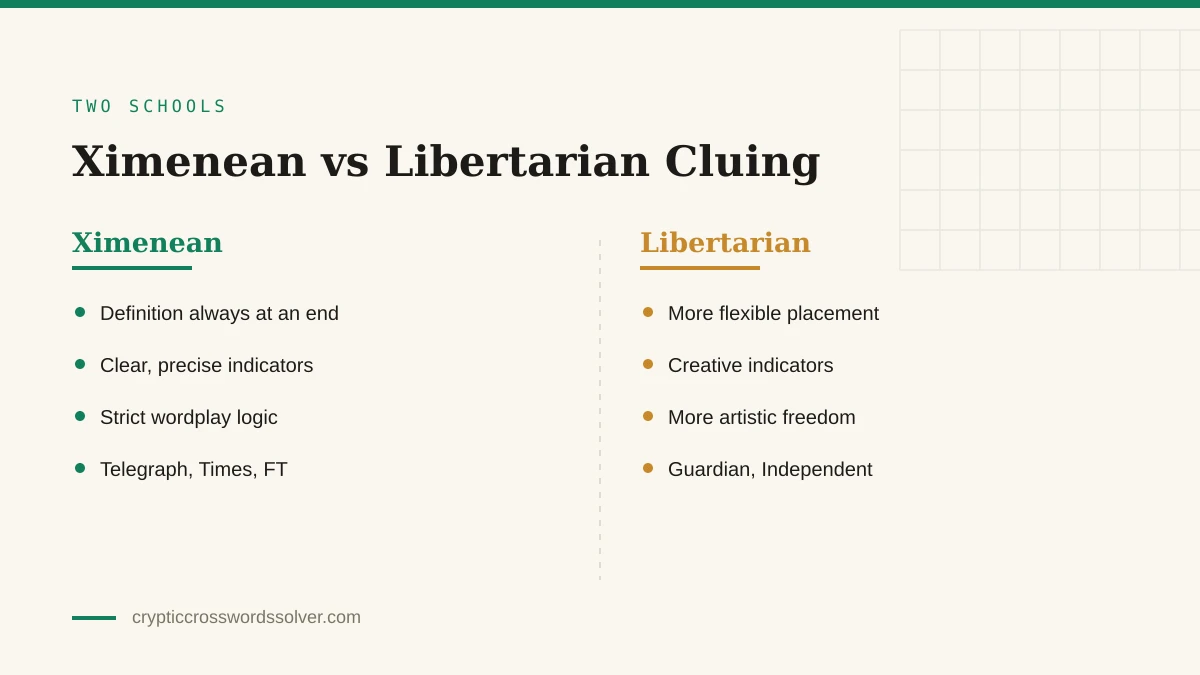
Not all crosswords follow the same rules. The Daily Telegraph follows strict Ximenean style, while newspapers like the Guardian often use a more flexible approach called Libertarian cluing.
| Feature | Ximenean (Telegraph style) | Libertarian (Guardian style) |
|---|---|---|
| Definition placement | Always at the start or end | Usually start or end, but more flexible |
| Indicator words | Clear and precise | More creative and flexible |
| Wordplay rules | Strict logic required | More artistic freedom |
| Cryptic definitions | Rare and controlled | More common and playful |
| Double meanings | Avoided unless necessary | Often used for style |
| Surface reading | Must still be grammatical | More focus on style and wit |
| Example publications | Telegraph, Times, Financial Times | Guardian, Independent |
In short, Ximenean clues are logical and fair, while Libertarian clues are creative and playful.
What Ximenean rules mean for you as a solver
If you are solving the Daily Telegraph crossword, Ximenean rules actually make things easier. They give you a reliable system to follow.
- The definition is always at the start or end of the clue, so you only need to check those parts first.
- Indicator words are always clear, so if something looks like an anagram indicator, it usually is one.
- Every word in the clue has a purpose. Nothing is random or decorative.
- There is only one correct answer, so if two answers seem possible, you need to recheck the wordplay.
Because of these rules, you can trust that every Telegraph clue is solvable using logic and careful analysis, not guessing.
Clue types you'll find in the Daily Telegraph cryptic
| Clue type | What it means | Common indicator words | Difficulty | Key idea |
|---|---|---|---|---|
| Anagram | Letters of a word are mixed to form a new answer | wild, mixed, broken, confused, upset, strange | Easy to medium | Rearranged letters form the answer |
| Hidden word | The answer is hidden inside the clue itself | in, inside, within, part of, buried | Easy | Find words hidden in the sentence |
| Charade | Answer is built by joining smaller word parts | after, before, then, follows, and | Easy to medium | Combine pieces like a puzzle |
| Double definition | One word with two different meanings | no indicator | Medium | Two meanings, same answer |
| Container | One word is placed inside another | in, inside, within, holding, around | Medium | One word contains another |
| Reversal | Letters are written backwards | back, reversed, returning, up | Medium | Reverse the word |
| Homophone | Words that sound like the answer | sounds like, we hear, reportedly | Medium | Based on sound, not spelling |
| Cryptic definition | A tricky, riddle-style definition | no indicator | Hard | Whole clue is a hidden meaning |
| &lit | Whole clue is both definition and wordplay | rarely any indicator | Very hard | Entire clue does double duty |
For a full breakdown of each mechanic with worked examples, see the complete guide to the ten cryptic clue types.
How to solve Daily Telegraph cryptic clues: a step-by-step method
This method works for both the standard daily cryptic and the Toughie, and it mirrors the general approach laid out in the complete beginner's guide. The difference between the two is not the process but the density and depth of the wordplay at each step.
- Ignore the surface reading completely. Read the clue once, then set aside whatever story it appears to be telling. A clue about a garden, a journey or a sports event is probably about none of those things. The sooner you stop trying to read the clue as a sentence and start reading it as a structure, the sooner you will solve it.
- Note the answer length and fill in any crossing letters. Write out the answer grid with dashes for unknown letters, and fill in every crossing letter you have from solved clues. Most answers cross at least three or four others, so a half-completed grid gives substantial information. Even a single confirmed letter can make an anagram obvious.
- Locate the definition. Test the first word or phrase, then the last. In a Ximenean puzzle, the definition is always at one of these two ends, never in the middle, and it functions as a clean synonym for the answer.
- Identify the wordplay type. Scan the remaining words for indicator words: anagram indicators (wild, confused, broken), hidden word indicators (in, inside, within), reversal indicators (back, returning, up) and container indicators (around, holding, in). If no indicator is visible and the clue is very short, it is probably a double definition.
- Work the wordplay from the inside out. For anagrams, write the fodder letters in a circle: this physically breaks the original word's pattern and makes rearrangements visible. For hidden words, run the clue text together with no spaces and scan for the answer length. For charades, identify each component and check what abbreviation or word it represents.
- Confirm both parts match. Your answer must satisfy the definition independently and also result from the wordplay independently. If only one part fits, the answer is wrong. When both parts agree, the answer is certain.
- Use crossing letters to confirm or eliminate. Check your candidate against the letters you already have in the grid. If any letter contradicts a confirmed crossing answer, your candidate is wrong and you need to recheck the clue.
Tips for solving the Telegraph Toughie
The Toughie demands a different mindset than the daily cryptic. The wordplay is denser, the surfaces are more deceptive, and the setter's personality matters more.
- Know your setter. Check which setter is on duty before you start. If it is Ray T, expect concise clues with elegant construction. If it is Elgar, expect complex, multi-layered wordplay. Dada will be witty and unconventional. Knowing what to expect calibrates your approach from the first clue.
- Start with the short clues. Short clues, especially three-word clues, are often double definitions or short anagrams. Solving one gives you crossing letters that unlock longer, more complex clues elsewhere in the grid.
- Read Big Dave's hints before the answers. Big Dave's blog structures its Toughie posts with progressive levels of help. Try the hint first, and use the answer only if it is still not clicking. This teaches you the wordplay logic rather than just filling in the grid.
- Trust the clue more than your first reading. If you cannot see how your first interpretation works, the setter has likely succeeded in misleading you. Strip the surface reading away and ask which word could be an indicator, and whether the definition might be at the other end than you assumed.
- Accept that partial solves are progress. Most experienced solvers do not complete the Friday Toughie in one unbroken run. They solve two-thirds, hit a wall, fill in crossing letters, and return to stuck clues with fresh eyes. Track your unaided clue count rather than overall grid completion.
Where to find Daily Telegraph cryptic crossword solutions
Whether you are completely stuck or simply want to check your workings, these are the resources solvers turn to most.
| Resource | Type | Best used for | Free? |
|---|---|---|---|
| Big Dave's Crossword Blog (bigdave44.com) | Blog with daily answers | Step-by-step explanation of every clue in Telegraph puzzles | Yes |
| Telegraph Puzzles (puzzles.telegraph.co.uk) | Official app and website | Playing and solving Telegraph crosswords online | 7-day free trial |
| FifteenSquared.net | Solution blog | Extra explanations for difficult clues | Yes |
| Wordplays.com | Word pattern tool | Finding answers using known letters | Free with sign-up |
| CrosswordSolver.com | Search tool | Helps when you know part of the answer | Yes |
| BestForPuzzles.com | Reference site | Information about setters and puzzle history | Yes |
How to use Big Dave's blog without spoiling the puzzle
- Try the puzzle first before checking the blog.
- Only open hints for clues you cannot solve.
- Use the reveal buttons to check one answer at a time.
- Compare the hint with your own thinking before looking at the solution.
- Read the comments to see how other solvers approached the clue.
- Save Toughie posts for when you are genuinely stuck.
Underlined words in a Big Dave post mark the definition. Capital letters mark the letters you need to rearrange. Bracketed words show the clue type or indicator, and star ratings show difficulty and how enjoyable the puzzle was.
Your progression path: from beginner to Toughie solver
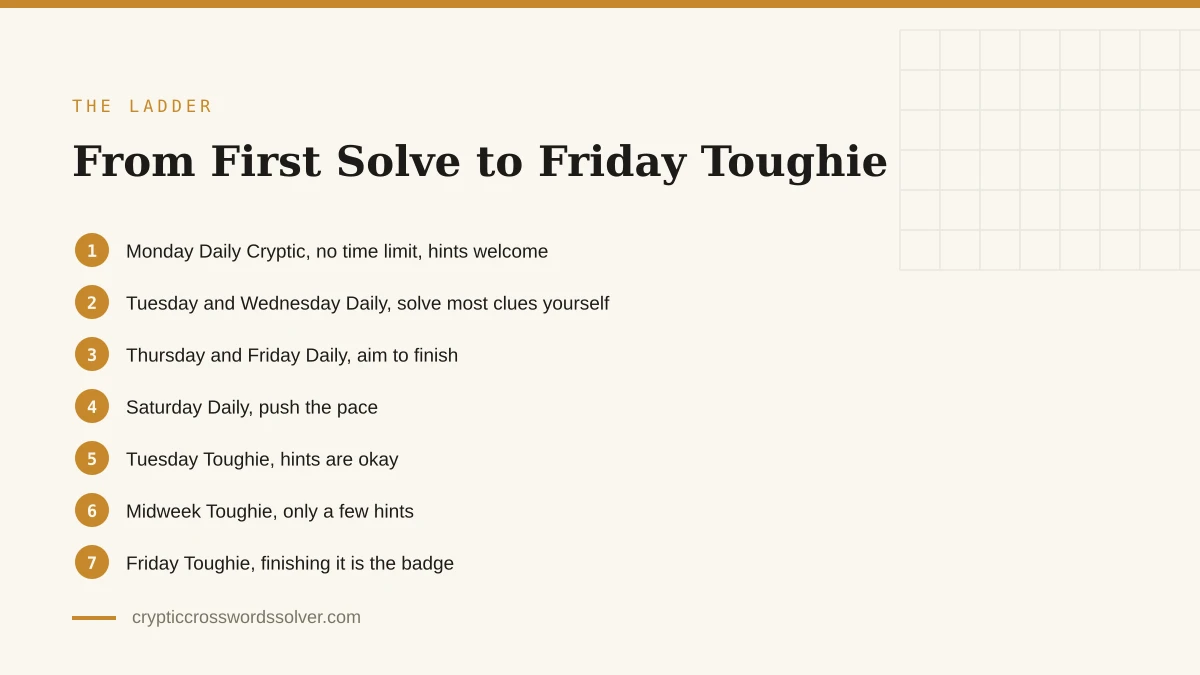
The Telegraph offers a natural ladder from accessible daily puzzles to the most demanding Toughie editions. Follow this path and you will build genuine cryptic solving ability without burning out on clues that are too hard for your current level.
| Stage | Skill level | Best puzzle to try | How long to take |
|---|---|---|---|
| 1 | Complete beginner | Monday Daily Cryptic | No time limit; use hints if needed |
| 2 | Building confidence | Tuesday to Wednesday Daily Cryptic | 45 to 60 minutes; try most clues yourself |
| 3 | Intermediate | Thursday to Friday Daily Cryptic | 30 to 45 minutes; aim to finish |
| 4 | Confident intermediate | Saturday Daily Cryptic | 20 to 30 minutes; try to solve faster |
| 5 | Ready for challenge | Tuesday Toughie | 60+ minutes; hints are okay |
| 6 | Experienced solver | Wednesday to Thursday Toughie | 45 to 60 minutes; only a few hints needed |
| 7 | Advanced solver | Friday Toughie | 45 to 60 minutes; finishing it is a strong achievement |
How long does progression take?
Most dedicated solvers who work through this ladder, solving daily and reviewing Big Dave's explanations for missed clues, find they can complete the Monday to Wednesday daily cryptic unaided within four to eight weeks. Moving to the Toughie comfortably typically takes six to twelve months of regular practice. There is no shortcut, but the improvement comes steadily and the satisfaction of each milestone is genuine.
Cryptic crossword publications: difficulty and style
| Publication | Difficulty | Style | Rules | Best for |
|---|---|---|---|---|
| Daily Telegraph (Daily Cryptic) | Medium | Fair and logical | Strict and rule-based | Players moving from beginner to intermediate |
| Daily Telegraph (Toughie) | Hard to very hard | More creative and tricky | Still fair, but more complex | Experienced solvers who want a real challenge |
| The Times | Hard | Very strict and precise | Very strict rules, the gold standard | Advanced solvers who like difficult but fair puzzles |
| The Guardian (Cryptic) | Medium to hard | Creative and playful | Looser rules, more flexibility | Solvers who enjoy clever and witty clues |
| The Guardian (Quiptic) | Easy to medium | Simple and beginner-friendly | Very fair and guided | Beginners learning how cryptics work |
| Financial Times | Medium to hard | Elegant and clean | Strict and fair | Solvers who like smooth, well-written clues |
| The Independent | Medium | Mixed styles, varies by setter | Moderately strict | Solvers who like different styles in one place |
The Telegraph crossword is popular with experienced solvers because the Daily Cryptic sits at medium difficulty, not too easy and not too hard, while the Toughie offers a much harder step up for expert players. People like the Telegraph because the clues are fair and follow clear rules: every answer can be worked out step by step without guessing.
Common abbreviations used in Telegraph cryptic crosswords
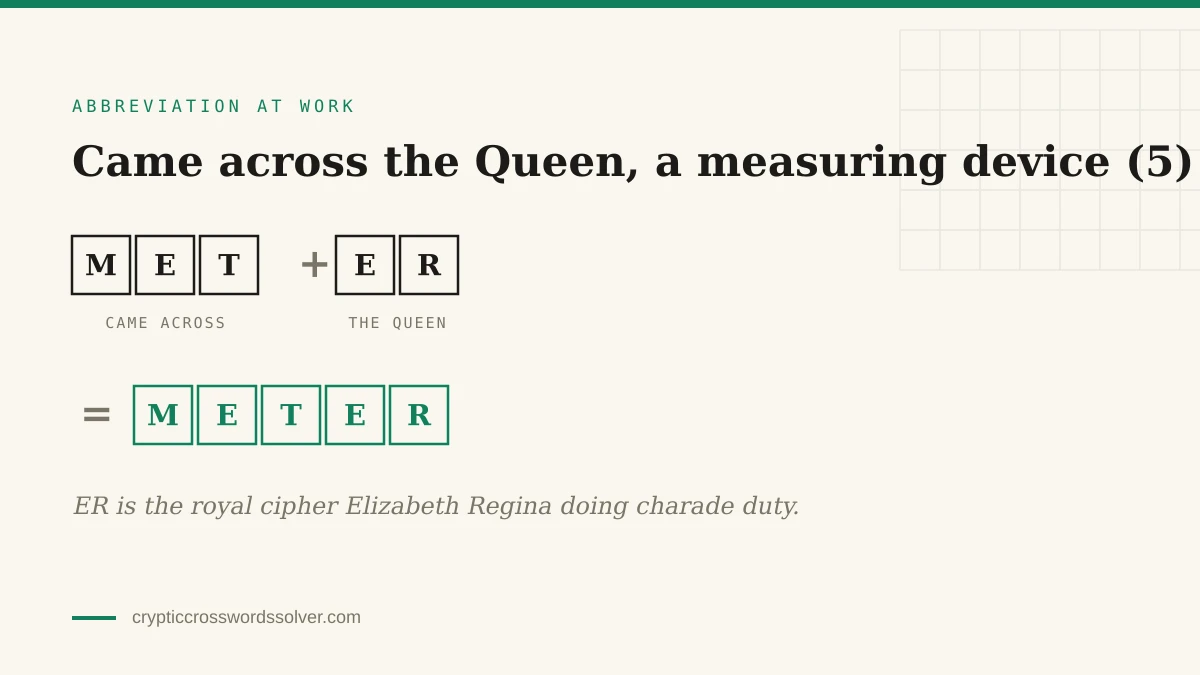
Abbreviations are used constantly in Telegraph clues. A word in the clue stands in for a short letter sequence that forms part of the answer.
| Word in clue | Abbreviation | What it means |
|---|---|---|
| About, regarding | RE | "about" |
| Queen, monarch | ER, R or Q | Queen or ruler |
| King | K or R | King |
| Doctor | DR, GP or MB | Doctor or physician |
| Soldier | GI, OR or PVT | Soldier |
| East | E | Direction east |
| Musical note | DO, RE, MI, FA, SOL, LA or SI | Music notes |
| Right | R | Right side |
| Left | L | Left side |
| Love, zero | O | Nothing or zero |
| Time | T | Time |
| Learner | L | Beginner driver |
| Roman numeral 50 | L | Fifty |
| Roman numeral 1 | I | One |
| Roman numeral 5 | V | Five |
| Roman numeral 10 | X | Ten |
| Roman numeral 100 | C | Hundred |
For the fuller picture, including the rarer setter-specific shorthand, see the complete cryptic crossword abbreviations reference.
Frequently asked questions
What is the difference between the Daily Cryptic and the Toughie? The Daily Cryptic is a normal crossword for regular players. It is medium difficulty and comes out every weekday. The Toughie is much harder and is made for expert players who want a bigger challenge.
Who makes the Daily Telegraph cryptic crossword? Different puzzle makers create the Daily Cryptic, and they do not always use their real names. The Toughie is made by well-known setters who use pseudonyms. The crossword section is managed by an editor.
Where can I find answers to today's Telegraph crossword? You can find explanations and answers on crossword help blogs like Big Dave's Crossword Blog. They show how each clue works in a simple way.
How do I play the Telegraph crossword online? You can play it on the Telegraph website or in their mobile app. A subscription is required, though a free trial is sometimes available.
Is the Telegraph cryptic crossword difficult? It is medium difficulty overall. Some days are easier and some are harder. Monday is usually the easiest day, and the Toughie is much harder.
What is special about the Toughie crossword? The Toughie is more difficult than the standard crossword. The clues are more clever and tricky, but they are still fair and follow the same Ximenean rules.
Who is Roger Squires? Roger Squires was a celebrated crossword compiler. He created thousands of puzzles over his career and was one of the most experienced setters in the world.
Can I solve the crossword on my phone? Yes. The Telegraph crossword app is available on Android and iPhone, and it lets you solve puzzles anywhere, even without an internet connection.
Conclusion
The Daily Telegraph cryptic crossword has been part of British daily life for a century. Its commitment to Ximenean principles means every clue plays fair, every answer is uniquely correct, and every solved puzzle delivers genuine satisfaction. Whether you are working through the accessible Monday cryptic or grinding through a Friday Toughie by Elgar, the logic is always there waiting to be found.
Use Big Dave's blog to learn from every clue you cannot crack, work through the progression path systematically, and learn your Toughie setter's style and use it. When the wordplay finally clicks, when both parts of the clue lock together and the answer is suddenly obvious, you will understand why this puzzle has kept its readers coming back every morning for a hundred years. Practise that instinct on the homepage, where the free solver is waiting.