Skip to content

Free solver · No sign-in

Verified examples only

Cryptic Crossword Solver: Crack Any Clue

Cryptic crosswords are one of the most rewarding, and frustrating, word puzzles in the world. Unlike standard crosswords, every single clue is a mini-puzzle in itself. There is a hidden logic inside each one, and once you learn to spot it, solving feels like cracking a code.

  • Runs entirely in your browser
  • Every example verified correct
  • No sign-up, no tracking
Live tool
Watch it solveAnagram

Wild west goulash (4)

Reading the wordplay…
words indexed
272,457
solving modes
6
clue types explained
10

The tool

The Cryptic Crossword Solver

A cryptic crossword solver helps when you are stuck on a clue and cannot spot the wordplay. These tools work differently from regular crossword solvers: the best ones let you enter a letter pattern and keyword to narrow results.

Crossword Solver

Runs in your browser

Keep the (4) at the end and the answer length is read for you.

Answer length

Optional — read automatically from the (7) at the end of the clue.

Type the letters you have from crossing answers and leave the rest blank, or use ? for gaps.

Try a verified example

Answers

Type your clue, then hit Find Answer. Everything runs on your device.

This tool finds matching words and patterns, but it does not read the clue for you. Always cross-check a candidate against both the definition and the wordplay before you write it in.

Everything runs on your device against a bundled English dictionary: no clue you type is ever sent to a server. The tool matches words and patterns; it does not read the clue for you. Confirm an answer only when both the definition and the wordplay agree.

The basics

What Is a Cryptic Crossword?

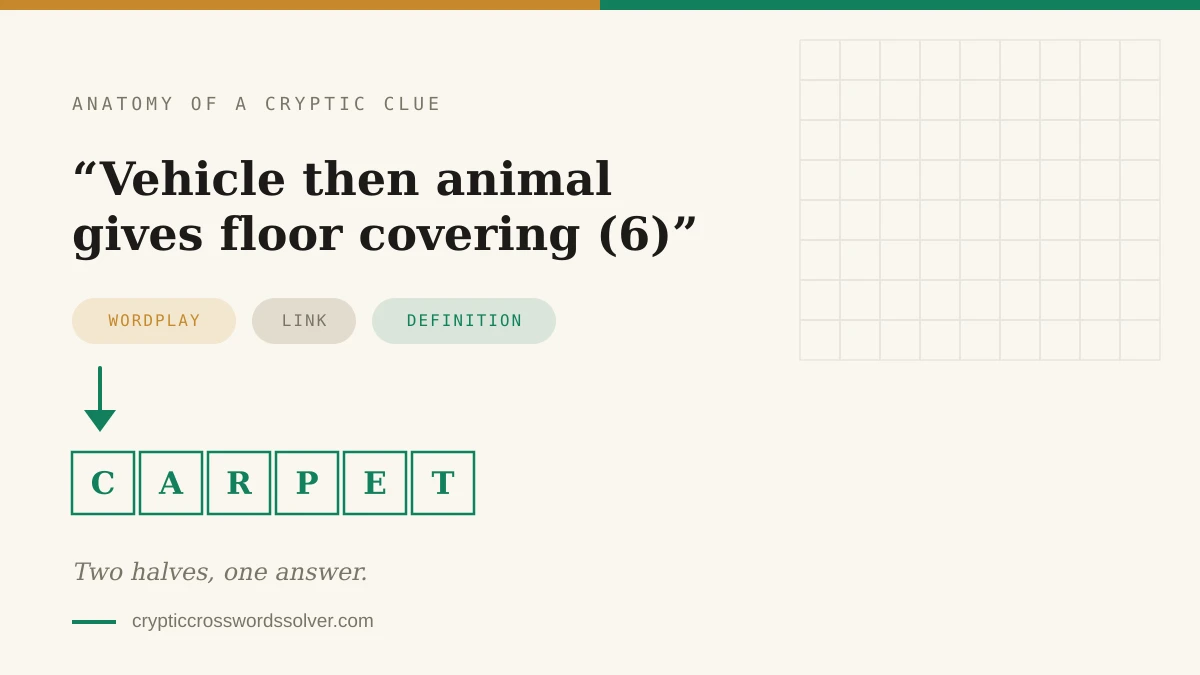
Diagram of the cryptic clue “Vehicle then animal gives floor covering” labelled with its wordplay, link word and definition, resolving to the answer CARPET

This guide gives you everything you need: a clear explanation of how cryptic clues work, every major clue type with examples, the best free cryptic crossword solver tools available, and a step-by-step method you can use right now.

A cryptic crossword is a crossword puzzle where every clue contains two separate parts: a straightforward definition and a wordplay element. Both parts lead to the same answer. Your job is to find the boundary between them.

Two parts, one answer. A definition and a wordplay element sit side by side. Your job is to find the boundary between them.

The surface reading lies. The surface reading of the clue (what it appears to say at first glance) is almost always a red herring. You have to read the clue in a completely different way to unlock the answer.

  • Definition
  • Indicator
  • Answer in tiles
A cryptic clue, taken apart

Clue: Wild west goulash (4)

Answer

“Goulash” is the definition: a goulash is a stew. “Wild” is the anagram indicator, telling you to jumble the letters beside it. “West” is the fodder: four letters, matching the (4). Rearranged, W-E-S-T gives STEW.

Indicator
Wild
Material
west

Anatomy

Anatomy of a Cryptic Clue: The Two Parts

Every well-formed cryptic clue contains exactly two parts. No more, no less.

Worked example

Vehicle then animal gives floor covering (6)

Answer

“Floor covering” is the definition. “Then” is the charade indicator: build the answer by writing one part after another. Vehicle gives CAR, animal gives PET, and CAR + PET = CARPET. “Gives” is a link word joining the wordplay to the definition.

Part 1

The Definition

This is a straightforward synonym or description of the answer. It always appears at the very start or the very end of the clue, never in the middle. It works exactly like a standard crossword clue.

Part 2

The Wordplay

The rest of the clue is an indirect route to the same answer. It uses a specific technique: an anagram, a hidden word, a reversal, and so on. Indicator words inside the clue signal which technique is being used.

Optional

The Link Word

Sometimes a short link word or phrase joins the two parts, words like “gives,” “is,” “from,” or “could be.” This helps the clue read as a natural sentence.

The content core

All 10 Cryptic Clue Types Explained

There are ten main clue types you will encounter in cryptic crosswords. Master these and you can solve almost any clue you face.

  • Definition
  • Indicator
  • Answer in tiles
Anagram

Clue: Wild west goulash (4)

Answer

“Goulash” is the definition: a goulash is a stew. “Wild” is the anagram indicator, telling you to jumble the letters beside it. “West” is the fodder: four letters, matching the (4). Rearranged, W-E-S-T gives STEW.

Indicator
Wild
Material
west
Look forwild, crazy, mixed, broken
Charade

Clue: Vehicle then animal gives floor covering (6)

Answer

“Floor covering” is the definition. “Then” is the charade indicator: build the answer by writing one part after another. Vehicle gives CAR, animal gives PET, and CAR + PET = CARPET. “Gives” is a link word joining the wordplay to the definition.

Indicator
then
Parts
CAR + PET
Look forafter, then, before, follows
Hidden Word

Clue: Annual, seen inside the cathedral very early (6)

Answer

“Annual” is the definition. “Seen inside” signals a hidden word. Read the rest of the clue as one unbroken run of letters and ignore the spaces: thecathedralver-YEARLY. The answer sits across the break between “very” and “early”.

Indicator
seen inside
Material
the cathedral very early
Look forin, within, inside, buried
Homophone

Clue: Uncovered bear, reportedly (4)

Answer

“Uncovered” is the definition. “Reportedly” is the homophone indicator: it tells you the answer sounds like a word in the clue. BEAR and BARE are pronounced identically, and BARE means uncovered. Four letters, matching the (4).

Indicator
reportedly
Material
bear
Look forsounds like, we hear, aloud
Reversal

Clue: Beer sent back is splendid (5)

Answer

“Splendid” is the definition. “Sent back” is the reversal indicator. “Beer” gives LAGER, and LAGER written backwards is REGAL, which means splendid. Both parts of the clue land on the same five-letter answer.

Indicator
sent back
Material
lager
Look forback, returned, reversed
Container

Clue: Cereal husk holding one, the organ of thought (5)

Answer

“The organ of thought” is the definition. “Holding” is the container indicator: one set of letters goes inside another. Cereal husk gives BRAN, and “one” gives I, the Roman numeral. Put I inside BRAN and you get BRA-I-N: BRAIN.

Indicator
holding
Parts
BRAN + I
Look forholding, around, inside
Double Definition

Clue: Dog's cry, tree's outer layer (4)

Answer

There is no indicator here, which is the giveaway. The clue is simply two separate definitions of the same word placed side by side. A dog's cry is a BARK, and a tree's outer layer is also BARK. Both meanings are genuine dictionary senses.

Look forNo special indicator
Deletion

Clue: Loaf loses its head, peruse what's left (4)

Answer

“Peruse” is the definition. “Loses its head” is the deletion indicator: drop the first letter. Loaf gives BREAD; remove the B and you are left with READ, which means peruse. Four letters, matching the (4).

Indicator
loses its head
Material
bread
Look forwithout, missing, losing
Initialism

Clue: Initially, Scientists Help Our Wildlife put on a display (4)

Answer

“Display” is the definition. “Initially” tells you to take first letters only. Scientists, Help, Our, Wildlife give S, H, O, W, spelling SHOW, which means a display.

Indicator
Initially
Material
Scientists Help Our Wildlife
Look forinitially, first letters
Spoonerism

Clue: Spooner's blushing crow, a devastating hit (8,4)

Answer

“A devastating hit” is the definition. “Spooner's” tells you to swap the opening sounds of the two words that follow. Swap the BL- and CR- of “blushing crow” and you get “crushing blow”, eight letters then four, matching the (8,4).

Indicator
Spooner's
Material
blushing crow
Look forSpooner said, reverend would say

The ten clue types at a glance

The ten cryptic clue types, their indicator words, how each works, and a verified example.
Clue typeIndicator wordsHow it worksVerified example
Anagramwild, crazy, mixed, brokenLetters are mixed to make a new wordWild west goulash (4)
Charadeafter, then, before, followsTwo or more word parts are joined togetherVehicle then animal gives floor covering (6)
Hidden Wordin, within, inside, buriedThe answer is hidden inside the clueAnnual, seen inside the cathedral very early (6)
Homophonesounds like, we hear, aloudThe answer sounds like another wordUncovered bear, reportedly (4)
Reversalback, returned, reversedLetters or words are read backwardsBeer sent back is splendid (5)
Containerholding, around, insideOne word goes inside another wordCereal husk holding one, the organ of thought (5)
Double DefinitionNo special indicatorThe clue gives two meanings of the same wordDog's cry, tree's outer layer (4)
Deletionwithout, missing, losingRemove letters to get the answerLoaf loses its head, peruse what's left (4)
Initialisminitially, first lettersFirst letters form the answerInitially, Scientists Help Our Wildlife put on a display (4)
SpoonerismSpooner said, reverend would saySwap starting sounds of wordsSpooner's blushing crow, a devastating hit (8,4)

For the same map with the rarer tricks folded in, read the complete guide to all ten cryptic clue types.

Deep dive

How to Solve Each Clue Type

Pick a clue type to see its indicator words, the step-by-step method, and two examples that both genuinely check out.

Anagram clues are the most common type in cryptic crosswords and a great starting point for beginners. The clue will contain an indicator word, something that means “mix up” or “change”, alongside the letters you need to rearrange.

Common anagram indicator words

  • wild
  • crazy
  • broken
  • drunk
  • confused
  • mixed
  • scrambled
  • upset
  • reformed
  • new
  • strange
  • odd
  • wrong
  • shaken
  • excited
  • troubled
  • involved
  • active
  • out
  • around

Step-by-step method

  1. Identify the indicator word (something that signals disorder or change)
  2. Identify the letters to rearrange (the “fodder”): these are usually the words directly next to the indicator
  3. Count the letters: they must match the answer length given in brackets
  4. Check the definition at the start or end of the clue
  5. Rearrange the letters until you find a word that fits the definition
Worked example

Clue: Wild west goulash (4)

Answer

“Goulash” is the definition: a goulash is a stew. “Wild” is the anagram indicator, telling you to jumble the letters beside it. “West” is the fodder: four letters, matching the (4). Rearranged, W-E-S-T gives STEW.

Indicator
Wild
Material
west
A second example

Clue: Attend to broken silent (6)

Answer

“Attend to” is the definition. “Broken” is the anagram indicator and “silent” is the fodder: six letters, matching the (6). S-I-L-E-N-T rearranges to LISTEN.

Indicator
broken
Material
silent

Want all nine mechanics laid out end to end with the indicator words, the method and worked examples in one place? Read the complete beginner’s guide to solving cryptic crosswords.

Using the tool

How to Use a Cryptic Crossword Solver

Six moves that turn a solver from a word list into a genuine solving aid.

  1. Count the letters in the answer
    Take the number in brackets, e.g. (7) means seven letters.

    (7) → 7 letters

  2. Enter any letters you already know
    Fill in the letters you have from crossing answers.

    _ _ A _ _ _ T

  3. Enter one or two keywords from the clue
    Pick keywords that might appear in the definition.
  4. Run the search and review the candidates
    Read down the list of candidate answers the tool returns.
  5. Cross-check each candidate against both parts
    Test every candidate against the definition AND the wordplay in the clue.
  6. Confirm only when both parts agree
    Commit to the answer only when both parts of the clue agree with your result.

The pattern field

What to enter for unknown letters

Use a question mark (?) or underscore (_) for unknown letters. For example, if you know the answer is 6 letters and ends in -ER, enter: ????ER. Most solvers accept both formats.

AT

Seven letters, A third, T last

ER

Six letters ending in -ER

Our solver accepts both formats. Type the letters straight into the squares and leave the gaps empty: the tool fills the blanks in for you.

Try the pattern search

The landscape

Best Free Cryptic Crossword Solver Tools Compared

Not all crossword solver tools handle cryptic clues equally well. Here is a comparison of the most useful free tools available today.

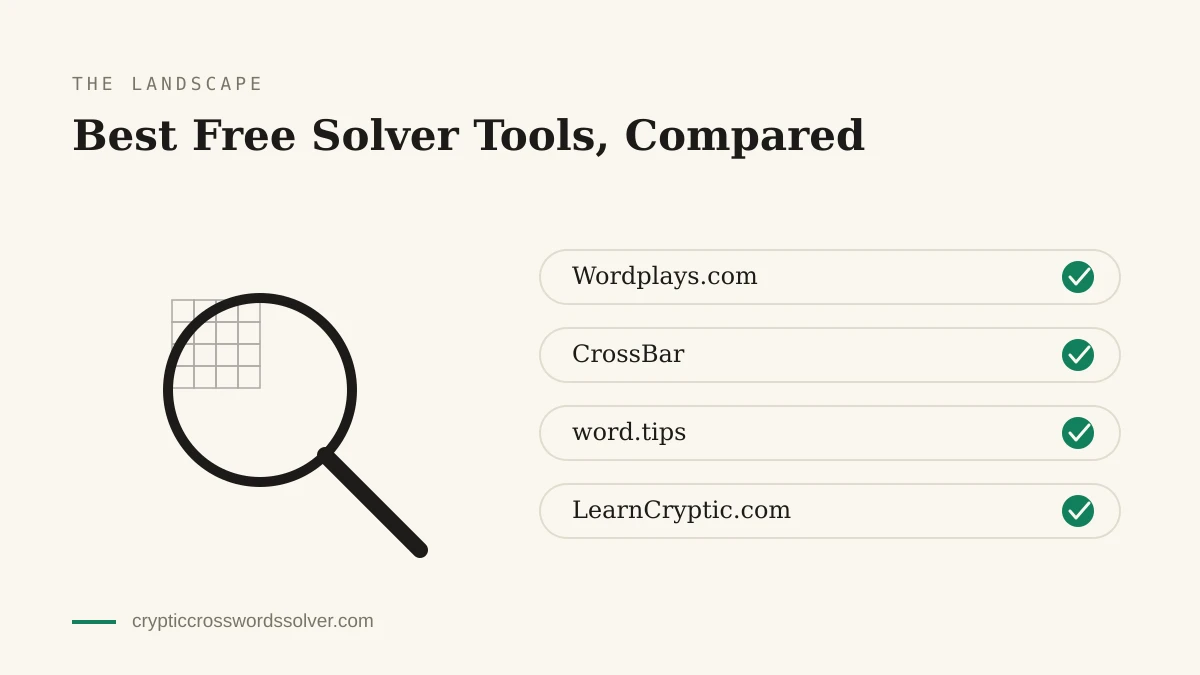
Illustration of a magnifying glass over a crossword grid beside a checklist of free cryptic crossword solver tools including Wordplays.com, CrossBar, word.tips and LearnCryptic.com

Which tool should you use?

For quick letter-pattern lookups
Wordplays.com or word.tips
For learning clue types
LearnCryptic.com or Minute Cryptic
For explained solutions to real published puzzles
FifteenSquared.net
For stuck on a particularly tricky puzzle
CrossBar (eobar.org), built for serious solvers

The method

6-Step Method for Solving Any Cryptic Clue

Follow this process for every clue and you will cut your solving time dramatically.

  1. Read the Whole Clue Without Jumping to Conclusions

    Read the clue slowly. Accept that your first impression of what it means is almost certainly wrong. The surface reading is designed to mislead you.
  2. Count the Letters

    The number in brackets tells you the exact answer length. If you see (3,5) it means two words: three letters and five letters. Write out that many blank spaces.

    (3,5) → _ _ _ / _ _ _ _ _

  3. Find the Definition

    Look at the first word or phrase, then look at the last word or phrase. One of them is the definition. Try both positions. The definition will match the answer like a standard crossword synonym.
  4. Identify the Wordplay Type

    Scan the rest of the clue for indicator words. Is there a word that means “mix up” (anagram)? A word meaning “sounds like” (homophone)? A word meaning “inside” (hidden word)? Match the indicator to one of the ten clue types.
  5. Work the Wordplay

    Apply the clue type mechanic. Rearrange letters for an anagram. Scan through consecutive letters for a hidden word. Reverse the fodder for a reversal clue. You should arrive at the same answer the definition pointed to.
  6. Verify Both Parts Agree

    Your answer must satisfy both the definition AND the wordplay. If only one part works, the answer is wrong. When both parts lock in, you can be confident: cryptic clues are self-checking.

See this method applied clue by clue in the full step-by-step solving guide, with every worked example checked letter by letter.

Course correction

6 Common Mistakes Beginners Make

Each of these costs new solvers more time than any single hard clue. All six are avoidable once you know the shape of them.

Trusting the Surface Reading

The mistake

The clue “Flower found in garden” is read as meaning a rose or a tulip.

Do this instead

“Flower” in cryptic crossword language often means something that flows: a river. Never take the surface reading literally.

Ignoring the Word Count

The mistake

An answer that fits the definition beautifully is written in, even though it is 5 letters and the clue says (4).

Do this instead

The numbers in brackets are exact. If you have (4) but your answer is 5 letters, it is wrong, no matter how well it fits the definition.

Forgetting to Check Both Clue Parts

The mistake

Beginners often find a word that fits the definition and stop there.

Do this instead

Always verify the wordplay part too. The answer must satisfy both simultaneously.

Missing That the Definition Can Be at Either End

The mistake

Only the beginning of the clue is checked for the definition, and the solve stalls.

Do this instead

The definition appears at the start OR the end of the clue. Always try both positions.

Not Knowing Indicator Words

The mistake

Without knowing what “reportedly” or “back” or “in” signal, the clue type stays invisible.

Do this instead

Building a mental library of indicator words is the single most valuable investment for new solvers.

Quitting Too Early

The mistake

A hard clue is abandoned before any crossing letters have been filled in.

Do this instead

Cryptic crosswords reward persistence. Fill in crossing letters from other answers first: even one or two known letters can make the answer click instantly.

Most of these trace back to not knowing the shape of a clue type on sight. The ten cryptic clue types, explained one at a time, fixes that.

Two traditions

British vs American Cryptic Crosswords

The same mechanics, two different house styles. Knowing which tradition a puzzle comes from tells you how strictly to expect the rules to be applied.

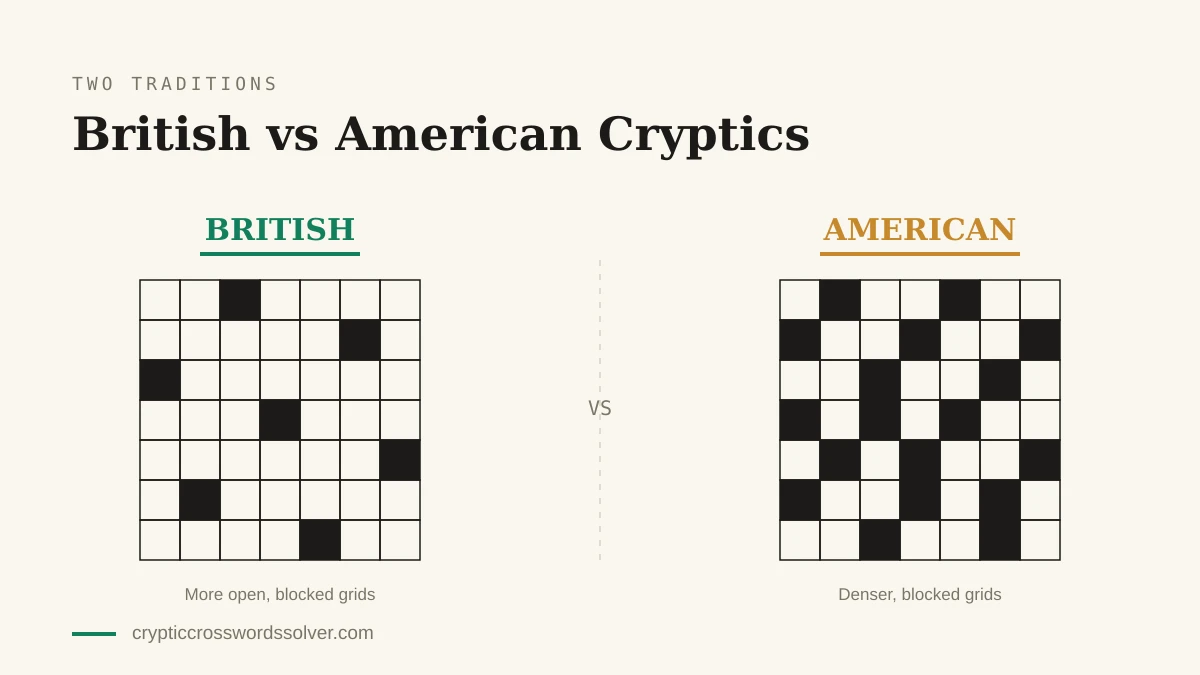
Side-by-side comparison of a British cryptic crossword grid, which is more open, and a denser American cryptic crossword grid
How British and American cryptic crosswords differ across grid style, clue rules, cultural references, difficulty, publications and the name given to the puzzle's creator.
FeatureBritish CrypticAmerican Cryptic
Grid StyleMore open blocked gridsOften denser blocked grids
Clue RulesFollows strict rulesRules are usually more flexible
Cultural ReferencesUK topics like cricket and politicsUS topics and culture
DifficultyUsually harderOften easier for beginners
Famous PublicationsThe Guardian, The Times, Daily TelegraphThe New Yorker, Harper's, The Nation
Puzzle Creator NameSettersConstructors

Cryptic crosswords originated in the UK and remain most popular there and in Commonwealth nations including Australia, Ireland, India, Canada, and New Zealand. In the United States, cryptics appear mainly in specialist publications and saw a surge in popularity following the COVID-19 lockdowns.

For the British tradition in detail, see our guide to the Daily Telegraph cryptic crossword, its Toughie, and the Ximenean rules behind both.

Quick reference

Indicator Words by Clue Type

Building a mental library of these is the single most valuable investment a new solver can make. Bookmark this section.

Anagram
  • wild
  • crazy
  • mixed
  • broken
  • confused
  • scrambled
  • upset
  • strange
  • wrong
  • changed
Hidden Word
  • in
  • inside
  • within
  • part of
  • hidden in
  • found in
  • among
  • contained in
Homophone
  • sounds like
  • we hear
  • aloud
  • spoken
  • they say
  • I hear
  • reportedly
Reversal (Across)
  • back
  • backward
  • returning
  • reversed
  • sent back
  • retreating
Reversal (Down)
  • up
  • rising
  • climbing
  • ascending
  • raised
Container
  • around
  • holding
  • surrounding
  • inside
  • within
  • embracing
Deletion
  • without
  • missing
  • losing
  • short
  • heads off
  • loses its head
Initialism
  • initially
  • first letters
  • starts with
  • begins
  • leads
Spoonerism
  • Spooner says
  • the reverend would say
  • spoonerism
Double Definition

Usually no special word; the clue simply gives two meanings

Charades and containers lean on their own short codes rather than words. The complete cryptic crossword abbreviations reference covers those.

Origins

A Brief History of Cryptic Crosswords

From plain definitional grids to a fully cryptic craft, in about a century.

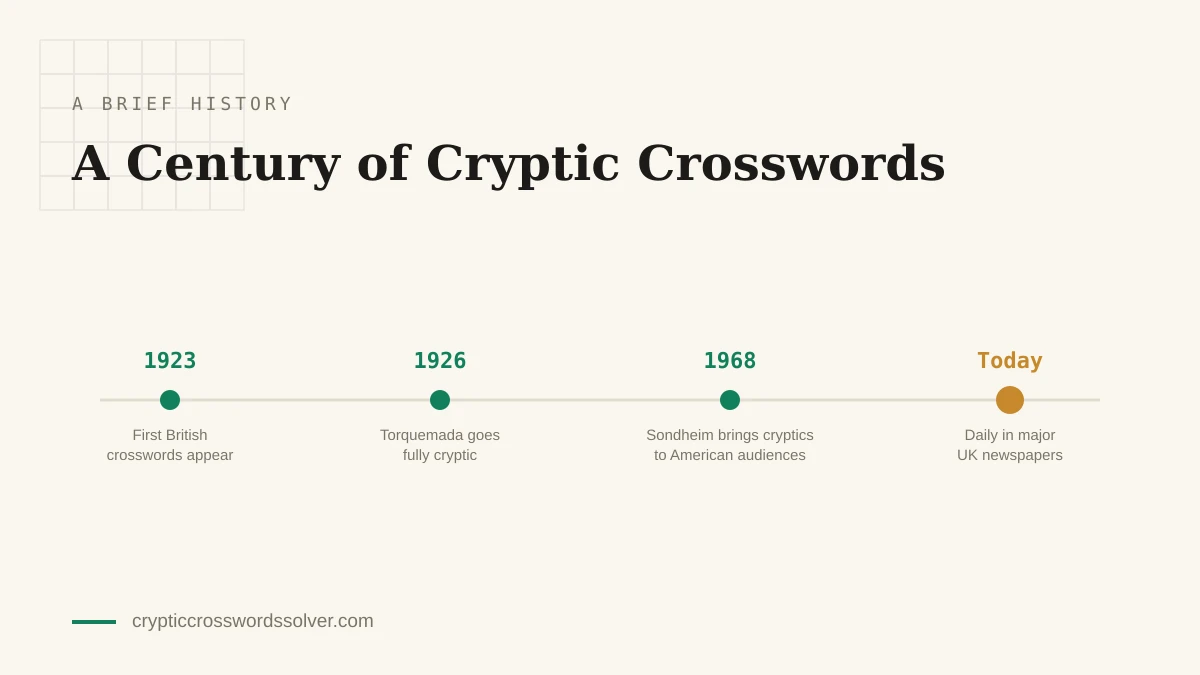
Timeline of cryptic crossword history: 1923 first British crosswords, 1926 Torquemada goes fully cryptic, 1968 Sondheim brings cryptics to American audiences, and today's daily UK newspaper puzzles
1923

The first British crosswords

Cryptic crosswords originated in the United Kingdom. The first British crossword puzzles appeared around 1923 and were purely definitional.

Mid-1920s

Wordplay arrives

From the mid-1920s they began to include wordplay elements: anagrams, allusions, and hidden clues.

1926

Torquemada goes fully cryptic

Edward Powys Mathers, writing as Torquemada for The Observer from 1926, is widely credited as the first setter to use cryptic clues exclusively.

Today

A daily fixture in the UK press

The craft was refined over decades, and today major UK newspapers including The Guardian, The Times, and The Telegraph publish daily cryptic puzzles.

1968

Sondheim brings cryptics to America

Composer Stephen Sondheim is credited with introducing cryptic crosswords to American audiences in 1968 through a series of puzzles he created for New York magazine.

One newspaper puzzle has almost the whole century to itself: the Daily Telegraph cryptic crossword, running continuously since 1925.

Questions

Frequently Asked Questions

The things new solvers ask most often about cryptic clues and the tools that help with them.

A cryptic crossword solver is a tool that helps you find answers to cryptic clues. You type the letters you know and use question marks or blanks for missing letters. The tool then shows possible answers.

Once you know the system, the puzzle becomes logic.

Cryptic crosswords are complex at first glance, but they operate on a clear set of rules. Every clue has a definition and a wordplay element. Every wordplay type has recognizable indicator words. Once you know the system, what looked like an unsolvable puzzle becomes a satisfying logical challenge.

Use a free cryptic crossword solver for the clues you are stuck on, but always cross-check the candidate answer against both parts of the clue.

The more you practice, the faster the logic becomes second nature, and solving cryptics by feel is one of the most satisfying skills a word puzzle lover can build.